
Custom Load Cells
Transcell engineers and manufactures custom load cells tailored to your exact specifications. From modified capacity ranges and environmental ratings to special materials and custom connectors, we deliver fully-integrated solutions with complete vertical integration — design, prototyping, calibration, and production under one roof.
TL;DR — Custom Load Cells at a Glance
- 12 families of load cell types available for customization (bending beam, S-beam, canister, digital, pancake, load pins, and more)
- Custom capacity ranges beyond standard catalog offerings
- Material options include stainless steel, alloy steel, Inconel, and titanium (consult factory for exotic materials)
- Custom cable lengths, connector types, and environmental ratings
- Digital output (RS-485, Modbus) and signal conditioning options
- 4–8 week typical lead time depending on design complexity
- Complete vertical integration: design review, prototyping, NIST-traceable calibration, production, ongoing support
- ISO 9001 certified manufacturing with individual calibration certificates included
Custom Load Cell Capabilities at a Glance
Why Choose Custom Load Cell Solutions
Standard catalog load cells serve the majority of applications, but some requirements fall outside typical capacity ranges, environmental conditions, or form factors. Transcell’s custom engineering approach begins with understanding your goals. Rather than forcing your application into a stock product, we design a solution that fits your mechanical constraints, performance targets, and budget.
Complete vertical integration means we control every step — design, material selection, manufacturing, calibration, and test. You work with one partner, not a chain of subcontractors. Design changes iterate quickly. Custom calibration curves, adjusted environmental ratings, and modified dimensions are executed in our Illinois facility, and your prototype moves to production faster than offshore quotes.

Load Cell Families Available for Customization
Every standard load cell in Transcell’s catalog is a starting point for customization. If your application requires a form factor not listed below, Transcell engineers can design from a blank slate.
Bending Beam
Hermetically sealed stainless steel, low-profile form factor. Customizable capacity ranges, cable types, and environmental ratings for platform scales and batching systems.
Double Ended Beam
Alloy steel shear beam for truck scales and heavy industrial platforms. Custom capacity, mounting patterns, and connector configurations.
Single Ended Beam
Nickel-plated cantilever for light-duty and OEM platform applications. Custom mounting patterns, cable exits, and environmental protection.
Planar / Single Point
Aluminum table-top form for bench scales and light industrial tables. Custom capacity, durometer, and cable management options.
S-Beam
Tension and compression capable across 25–10,000 lb. Custom capacity ranges, materials, connectors, and temperature compensation.
Mini S-Beam
Compact S-beam for medical devices, robotics, and laboratory equipment. Custom dimensions, potting compounds for biocompatibility, sealed or vented.
Parallelogram / Belt Buckle
High-precision force measurement in tension, compression, or dynamic loading. Customizable with special material selections.
Pancake / Low-Profile
Flat compression geometry for press testing and in-line force monitoring. Custom diameter, height, and sealing options.
Canister / Column
Heavy industrial compression cells for bin weighing, tank support, and static loading systems. Custom capacity and environmental ratings.
Digital Output
RS-485 / Modbus output built in. Drop-in replacement for systems requiring digital integration without external signal conditioning.
Load Pins
Double-ended shear pins for pin replacement in hinges and fixtures. Custom diameter, length, and environmental sealing.
Wireless Load Cells
Battery-powered load cells with wireless transmission for rotating machinery, remote monitoring, and installations where cable routing is impractical. Custom frequency, protocol, and enclosure options available.
Don’t see your form factor?
Transcell engineers custom geometries from scratch for OEM, aerospace, medical, and industrial applications. Beyond form factor, nearly every parameter is open for customization: capacity ranges, cable types and lengths, environmental and IP ratings, materials (stainless steel, alloy steel, Inconel, titanium, aluminum), mounting patterns, connector configurations, custom dimensions, cable exits, temperature compensation range, communication protocol (RS-485, Modbus, 4–20 mA, 0–10 V), output signal level, and connector type. If your application has a requirement not covered by any standard catalog product, contact our engineering team and we will propose a solution within 48 hours.
What Can Be Customized
Transcell’s custom capabilities extend far beyond selecting a standard model from a catalog. Our engineering team works with you to modify nearly every aspect of the load cell to fit your application.
Capacity Ranges
Need a 125 kg or 275 kg model when we only stock 100 kg and 300 kg? Custom capacities are designed to your exact specification. Whether you need a higher upper range for safety margin or a lower range for improved sensitivity, we engineer the geometry and material thickness to hit your target load point within ±2%.
Cable Length & Connector Types
Standard cable is typically 3 meters with a commercial LEMO connector. Custom runs extend to 50+ meters with signal conditioning. Industrial environments may require M12 (IEC 61076-2-109) connectors, military-spec MIL-DTL-38999 couplings, or potted connectors with cable glands. Transcell stocks connectors and assembles to your specification.
Materials & Environmental Ratings
Stainless steel 316 resists corrosion in humid and coastal environments. Alloy steel with special coatings survives washdown systems. For aerospace or high-temperature process equipment, Inconel 625 or titanium withstand extreme conditions. Temperature compensation extends from -40°C to +120°C on request. We adjust potting compounds for food-grade, medical, or chemical-resistant applications.
Custom Output Levels & Signal Conditioning
Standard models output 2.0 mV/V. Some systems require 3.0 mV/V or even 5.0 mV/V for better signal-to-noise on short cable runs. Digital options include 4–20 mA output conditioning, 0–10 V analog, or full RS-485 Modbus output with meter interfaces built into the connector head.
OEM Branding & Labeling
Your company name, part number, and traceability label laser-etched or silk-screened on the cell housing. Custom packaging with printed certificates, documentation, and fixture drawings prepared to your specifications.
Custom Calibration Curves & Certificates
Each load cell is individually calibrated and supplied with a NIST-traceable certificate documenting output at zero, 25%, 50%, 75%, and 100% of rated load. For OEM integrators, calibration curves can be linearized or adjusted to match your control system firmware.
Modified Physical Dimensions
Standard mounting patterns don’t always fit. Transcell engineers custom footprints — different bolt spacing, threaded inserts instead of drilled holes, extended shanks, or reduced heights. We provide CAD drawings for your assembly team before first article manufacturing.
Who Custom Solutions Are For
The Custom Engineering Process
Transcell’s approach to solving your challenges begins with understanding your goals. A structured workflow reduces design risk and avoids costly rework.
Step 1: Consultation & Requirements Definition
You describe your application: expected load range, mounting space, environmental conditions, electrical interface, and volume requirements. Our application engineers ask clarifying questions — Is there dynamic loading? What temperature extremes? Any chemical exposure? Do you need digital output or analog mV/V? This consultation typically takes 2–3 business days and is included in the custom engineering cost.
Step 2: Design Review & Proposal
We propose a load cell design — family selection, material, rated capacity, cable specification, and custom features. A preliminary CAD drawing and electrical schematic are prepared. Cost estimate and lead time quote follow. You review and confirm the approach before we commit manufacturing resources.
Step 3: Prototype Fabrication & Testing
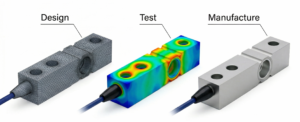
The first article is manufactured in-house using production tooling. Strain gauge bonding, hermetic sealing, and custom connector assembly are completed. Prototypes are calibrated, temperature-cycled, and bench-tested to verify performance against your specifications. CAD and test reports are delivered for your review before production release.
Step 4: Calibration, Documentation & Handoff
The approved prototype is transferred to production quality control. Each load cell is individually calibrated on dead-weight test stands. NIST-traceable certificates are generated with custom curves and engineering notes. Custom packaging, instruction cards, and CAD assemblies are finalized. Full traceability documentation is prepared for your records.
Step 5: Production Ramp & Ongoing Support
Once you approve production samples, we scale manufacturing to meet your delivery schedule. Transcell maintains complete manufacturing records and design documentation for the life of your product. Engineering support is available for field troubleshooting, recalibration schedules, and design changes as your application evolves.
Standards & Quality Assurance
Transcell manufactures under ISO 9001 certification. All custom load cells are designed, built, and tested in the same ISO 9001 environment as our standard catalog products. This means your custom solution inherits the same quality systems, traceability, and continuous improvement processes.
Every load cell — whether standard or custom — receives individual calibration on dead-weight test stands before shipment. This is not batch sampling or statistical sampling. Your 50 custom cells each get their own calibration point. NIST-traceable calibration means the test weights, reference standards, and measurement equipment used during calibration chain back to the National Institute of Standards and Technology. For regulated industries (pharma, food processing, aerospace), this traceability is a purchasing requirement.
Custom calibration certificates document actual output at zero load, 25%, 50%, 75%, and 100% of rated capacity. If your application requires linearization or custom curve fitting, we adjust the coefficients and supply your control system firmware with the exact compensation. Full dimensional drawings, material certificates, and connector specifications are included in the engineering package.
How Transcell Compares
Custom load cell engineering typically requires 12–16 weeks when sourced from overseas manufacturers. Long lead times stem from geographic distance, language barriers, and limited prototyping flexibility. Transcell’s Illinois-based engineering and manufacturing teams compress the custom timeline to 4–8 weeks. Design review questions are answered same-day. Prototypes iterate on-site. You avoid costly overseas shipping delays and customs clearance delays.
Many overseas suppliers require large minimum order quantities (500–1,000 units) for custom designs. Transcell delivers custom solutions starting at 10 units. OEM partners place small initial runs to validate fit, function, and integration, then scale production without re-engineering. This reduces financial risk and accelerates time-to-market.
Engineering consultation is built into every custom quote at no additional charge. Transcell engineers work with you on capacity selection, material tradeoffs, connector options, and environmental specifications. Competitors often charge consulting fees (typically $2,000–5,000) before providing a quote. We treat engineering collaboration as part of the partnership.
Manufactured in Buffalo Grove, Illinois since 1981, Transcell maintains complete vertical integration. We design, machine, assemble, calibrate, and test every cell. Subcontractors are minimized. This control reduces quality risk and shortens lead times compared to companies that outsource manufacturing and rely on contract manufacturers.
Related Standard Products (Starting Points for Customization)
Frequently Asked Questions
Discuss Your Custom Load Cell Requirements
Share your application, capacity range, environmental conditions, and integration needs. Transcell will propose a design and timeline within 48 hours.
Custom Engineering Support
Our engineering team has three decades of experience solving custom load cell challenges.
From aerospace and medical device manufacturers to food processing and industrial automation, we deliver vertically-integrated solutions with faster lead times and direct accountability.
Transcell Technology Inc. · Buffalo Grove, IL · ISO 9001 Certified · Since 1981