
Hazardous Environment Load Cells
Intrinsically safe weighing systems for Class I/II and ATEX-compliant applications. Transcell integrates industry-standard sensors with certified barriers and enclosures.
TL;DR
- Hazardous environment load cells combine standard transducers with intrinsic safety (IS) barriers to operate safely in explosive atmospheres.
- Transcell sources compatible load cells and provides integration with FM/CSA/ATEX-certified barriers and enclosures.
- Applications include chemical plants, oil & gas, grain storage, pharmaceuticals, paint facilities, and mining.
- NEC Class/Division and ATEX Zone classifications determine the protection method required.
- Engineering consultation available to specify the correct barrier, enclosure, and load cell combination.
What Are Hazardous Environment Load Cells?
Hazardous environment load cells are weighing transducers configured to operate safely within areas where explosive atmospheres may be present. These areas are defined by regulatory classifications such as NEC (National Electrical Code) Class I, Class II, and ATEX (Atmosphères Explosives) zones.
A hazardous environment load cell system typically consists of three components: a standard load cell sensor, an intrinsic safety (IS) barrier or galvanic isolator, and an explosion-proof or sealed enclosure. The barrier limits electrical energy to levels insufficient to ignite the surrounding explosive atmosphere.
Transcell does not manufacture load cells that are themselves FM or ATEX certified as intrinsically safe. Instead, Transcell sources or supplies compatible load cells and provides engineering guidance to integrate them with FM-certified barriers, CSA-approved isolators, and ATEX-compliant enclosures. This modular approach allows customers to meet site-specific hazardous area requirements without overspecifying equipment.
Why Intrinsic Safety Barriers Matter
Intrinsic safety is a design philosophy where electrical energy is restricted at the source, preventing ignition of hazardous gases, vapors, or dust. A Zener barrier or galvanic isolator absorbs excess voltage and current, ensuring that the circuit connected to the load cell operates well below the ignition threshold of the surrounding atmosphere. This is verified through FM (Factory Mutual) or ATEX certification testing.
Classification Systems: NEC Class/Division vs. ATEX Zones
Two primary regulatory frameworks govern hazardous area equipment worldwide. Understanding the distinction is essential for specifying the correct protection method.
| Standard | Region | Classification Approach | Categories | Key Characteristics |
|---|---|---|---|---|
| NEC (Article 500) | North America (USA, Canada) | Class/Division | Class I (gases), Class II (dusts), Class III (fibers) | Division 1 = likely presence; Division 2 = abnormal conditions |
| ATEX | Europe, and internationally | Zone / Category | Zone 0, 1, 2 (gases); Zone 10, 11, 20, 21, 22 (dusts) | Zone 0/10 = likely; Zone 2/22 = unlikely during normal operation |
| IECEx | International | Zone / Equipment Group/Category | Equipment Group I (mining), Group II (surface industries) | International certification reciprocity; accepted globally |
Within these frameworks, equipment is assigned specific protection methods: intrinsic safety (IS), explosion-proof enclosures (EX d), increased safety (EX e), or sealed containers (EX p). Hazardous area load cell systems often use IS barriers for cost-effectiveness and flexibility.
Protection Methods for Hazardous Area Weighing
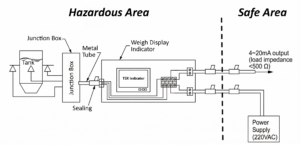
Intrinsic Safety Barriers (IS)
An intrinsic safety barrier is an electronic device installed between the load cell and the display/controller. It limits voltage and current to levels incapable of igniting the atmosphere. Zener barriers (passive diodes) and galvanic isolators (active circuits) are the two main types.
Zener Barriers: Passive components using Zener diodes to clamp voltage. No power supply required. Suitable for simple 4-20 mA signal circuits.
Galvanic Isolators: Active circuits that electrically separate the load cell circuit from the display circuit. Provide signal conversion and do not conduct ground loops. Preferred for multi-channel systems or high-impedance circuits.
FM and CSA certify these barriers for specific hazardous classifications. The certification documents the maximum voltage, current, and inductance/capacitance that can safely be connected.
Explosion-Proof Enclosures
An explosion-proof (EX d) enclosure is a sealed, heavy-walled steel housing designed to contain an internal explosion without rupturing. All external surfaces remain below ignition temperature. This method is more robust for harsh industrial environments but heavier and more expensive than IS barriers.
Transcell can supply or recommend explosion-proof junction boxes and indicator housings for customers requiring this protection method.
Sealed and Pressurized Housings
In some applications, sealed or pressurized enclosures (EX p / EX px) are used. These prevent explosive atmosphere from entering the enclosure by maintaining an inert gas or positive pressure.
Transcell’s Hazardous Environment Integration Approach
Transcell Technology does not position itself as a hazardous area load cell manufacturer per se. Instead, Transcell leverages industry-standard load cells paired with certified barriers and enclosures to deliver cost-effective, field-proven hazardous area solutions.
Three-Tier Integration Model
Tier 1: Load Cell Selection. Transcell sources or manufactures load cells compatible with intrinsic safety barriers. Standard load cells operate with 4-20 mA or 0-10 V output. These are then interfaced with FM or CSA-approved barriers.
Tier 2: Barrier Integration. Transcell specifies the correct barrier type and certification class for the customer’s hazardous location. Engineering validates the circuit design, lead routing, and grounding scheme per the barrier’s certification documents.
Tier 3: Enclosure and Field Installation. The integrated system is housed in an approved enclosure (explosion-proof, sealed, or pressurized). Transcell provides installation guidelines, certification documentation, and post-installation verification support.
Why This Approach Works
Modular integration avoids overengineering. A customer in a Class II, Division 2 grain elevator environment may need only a basic IS barrier, whereas a petrochemical plant in a Zone 1 environment may require redundant barriers or explosion-proof housings. Transcell’s engineering team sizes the solution to the risk level.
This model also aligns with regulatory practice. The barrier manufacturer holds the FM/ATEX certificate. Transcell documents the system integration in a hazardous area application note, verifying that the combined system meets the site safety requirements.
Compatible Transcell Products for Hazardous Area Integration
Transcell manufactures and supplies several load cell models suitable for pairing with intrinsic safety barriers and explosion-proof enclosures:
Single-Ended Shear Beam Load Cells (SBS / SBSB)
Compact, stainless steel construction ideal for tank weighing systems in chemical and food processing plants. The SBS and SBSB models operate with 4-20 mA output and are compatible with standard 24 V intrinsic safety barriers. Learn more about single-ended shear beams.
Double-Ended Shear Beam Load Cells (DBS)
Heavy-duty sensors for weighing large vessels, reactors, and hoppers in hazardous environments. The DBS accommodates dual load cells for redundancy, critical in high-consequence applications. Explore double-ended shear beam specifications.
Bending Beam Load Cells (BSH)
IP67 and IP68 hermetically sealed load cells with robust stainless steel construction. The BSH is engineered for extreme moisture, dust, and corrosion resistance in oil, gas, and mining applications. Ideal for outdoor or washdown environments requiring both hazardous area compliance and environmental sealing. View bending beam load cell details.
Compression Load Cells
For applications requiring vertical load measurement, such as reactor pressure vessels or stacking scales. Available in stainless steel with ranges to 200+ tons. Check compression load cell specifications.
Digital Indicators and Controllers
Transcell manufactures digital weight indicators that integrate with intrinsic safety barriers. Indicators can be mounted in explosion-proof enclosures or pressurized housings. Review indicator and controller options.
Junction Boxes and Wiring Enclosures
Explosion-proof and sealed junction boxes for multi-channel systems or remote mounting. These enclosures house signal conditioning electronics and are rated for Class I/II, Division 1 or ATEX Zone 1/2 environments. Browse junction box specifications.
Application Sectors for Hazardous Environment Load Cells
Chemical Manufacturing & Processing
Chemical plants frequently handle flammable solvents, reactive compounds, and pressurized vessels. Load cells installed on reactor tanks, distillation columns, and storage vessels must comply with Class I, Division 1 or ATEX Zone 0/1. Transcell’s SBS/SBSB single-ended beam cells paired with FM-certified IS barriers are standard in this sector.
Oil & Gas Exploration and Refining
Offshore platforms and onshore refineries demand load cells for crude oil storage tanks, separator vessels, and shipping containers. The high-consequence nature of this industry often requires redundant load cells and explosion-proof housings. DBS double-ended sensors ensure reliability in Class I, Division 1 / ATEX Zone 1 environments.
Grain Elevators and Agricultural Storage
Grain dust presents a significant explosive hazard. Facilities storing corn, wheat, or flour require load cells for bulk weighing that comply with Class II, Division 1 or ATEX Zone 21 standards. SBS and DBS load cells with sealed enclosures prevent dust ingress and meet regulatory requirements.
Pharmaceutical Manufacturing
Sterile manufacturing environments sometimes handle flammable alcohols, acetones, or other volatile components. Hazardous area load cells ensure weighing accuracy without ignition risk. IP67/IP68 sealed load cells protect against moisture contamination in cleanroom environments.
Paint, Coating, and Solvent Facilities
Paint manufacturers and coating applicators work with combustible liquids. Load cells used on raw material or product tanks must operate safely in Class I, Division 2 or ATEX Zone 2 areas. Intrinsic safety barriers are cost-effective for these less-severe classifications.
Mining and Metalworking
Certain mining operations (coal, methane-rich deposits) require Class I equipment. Metalworking shops that use flammable coolants need hazardous-area-rated scales. Transcell supplies load cells for hopper, skip, and ore car weighing in these environments.
Hazardous Area Load Cell Selection Guide
Specifying the correct system requires understanding the site environment, regulatory framework, and operational requirements.
Step 1: Identify Your Hazardous Classification
In the USA/Canada: Consult your facility’s electrical code documentation or request a hazardous area classification survey from a licensed engineer. Determine your Class (I, II, or III) and Division (1 or 2).
Outside North America: Use ATEX Zone classification (0-2 for gases, 10-22 for dusts) or request IECEx certification equivalency. Many countries follow ATEX or IEC standards.
Step 2: Select Your Load Cell Type
Match your installation requirement to a Transcell load cell category: single-ended beam for small tanks, double-ended for large vessels, bending beam for seal-critical environments, or compression cells for stack applications.
Step 3: Specify the Barrier or Enclosure Protection Method
For Class II/Division 2 or lower-risk ATEX zones, an intrinsic safety barrier may be sufficient. For Class I/Division 1 or Zone 1/21, verify that the barrier is certified for that classification. For high-consequence applications, explosion-proof enclosures may be mandated.
Step 4: Verify Output Signal Compatibility
Most intrinsic safety barriers are designed for 4-20 mA loop or 0-10 V analog signals. Confirm that your load cell output matches the barrier input specification and that the total circuit inductance and capacitance remain within the barrier’s certified limits.
Step 5: Document and Inspect
Upon installation, verify that all cable runs, enclosure seals, and grounding schemes comply with the barrier’s certification data sheet. Request documentation from the barrier or enclosure manufacturer confirming the system design.
Installation and Certification Considerations
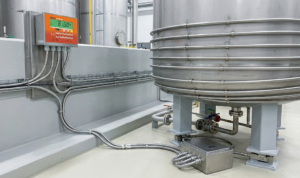
Cable Routing and Segregation
Cables connecting the load cell to the intrinsic safety barrier must be routed through approved conduit or cable glands. In explosive atmospheres, segregation prevents cross-coupling of energy from non-hazardous circuits into the IS circuit.
Grounding and Bonding
All metal enclosures must be properly grounded to prevent static discharge. The barrier’s certification documents specify grounding requirements. Inadequate bonding can compromise the IS design.
Temperature Derating
Intrinsic safety barriers have maximum operating temperatures. In hot industrial environments (furnace rooms, direct sun exposure), derating curves may reduce the permissible signal level. Confirm that the site temperature range remains within the barrier’s operating limits.
Regular Inspection and Maintenance
Hazardous area systems require periodic inspection for seal degradation, corrosion, or cable damage. Develop a maintenance schedule aligned with your facility’s regulatory framework (OSHA, local electrical inspector, or ATEX compliance authority).
Documentation and Certification Records
Maintain copies of all barrier and enclosure certifications, system design notes, and installation photographs. In case of incident investigation or regulatory audit, these documents prove that the system was properly designed and installed.
Relevant Standards and Certifications
Hazardous area load cell systems are subject to multiple regulatory and technical standards depending on geographic location and industry sector:
North America
- NEC Article 500: National Electrical Code classification of hazardous (classified) locations.
- FM Approval: Factory Mutual’s certification program for equipment and systems in hazardous areas.
- CSA Certification: Canadian Standards Association (now CSA Group) for electrical safety and hazardous area approval.
- ANSI/ISA Standards: Instrumentation standards for transducers and control systems.
Europe and International
- ATEX Directives (2014/34/EU): European Union framework for equipment used in potentially explosive atmospheres.
- IEC 60079 Series: International standards for explosion prevention, including IS device standards (IEC 60079-11).
- IECEx Certification: International Electrotechnical Commission system for mutual recognition of explosive atmosphere equipment.
General Best Practice
- IEEE 1451: Smart transducer interface standard for sensor networks.
- NFPA Guidance: National Fire Protection Association publishes technical guidance on hazardous area design (NFPA 497, 498).
Transcell remains current on evolving standards and can assist in navigating certification requirements for your specific application. Review Transcell’s certifications and compliance documentation.
Frequently Asked Questions
Ready to Specify Your Hazardous Area Load Cell System?
Transcell’s engineering team is ready to guide you through classification, product selection, and barrier integration. Contact us for a consultation.
Hazardous Area Engineering Support
Transcell provides custom integration services for complex hazardous environment applications.
From classification verification to final documentation, our engineers ensure compliance and performance.
sales@transcell.com