Weigh Beams
5040 AWP / SWP · 5,000 lb portable NTEP — temporary truck weighing, livestock, rental-fleet scales.

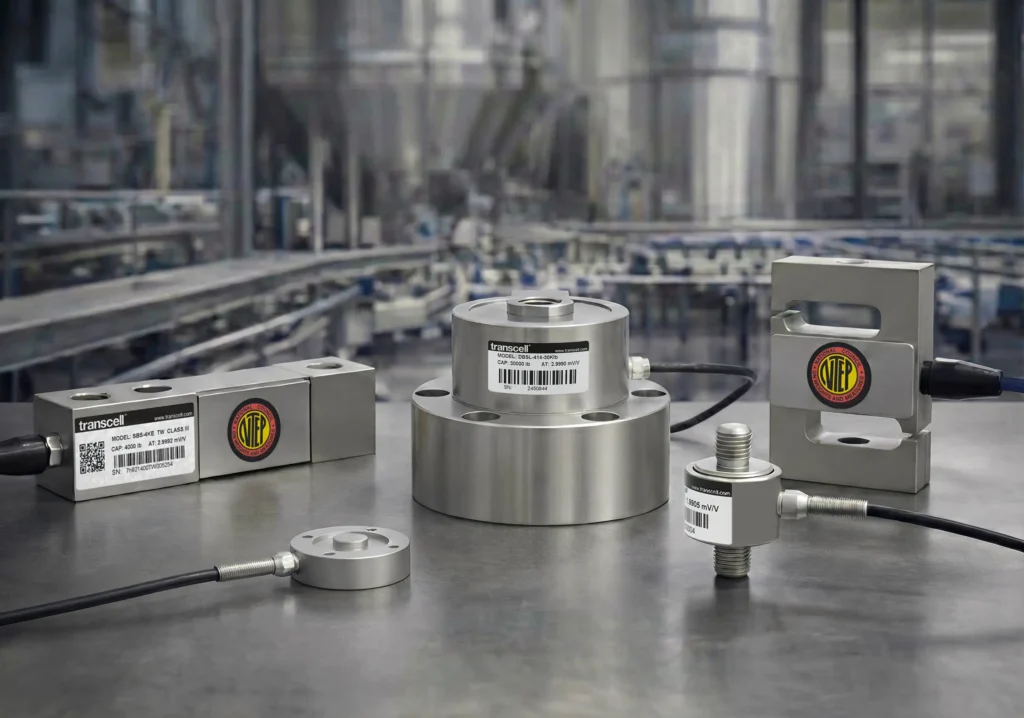
Transcell Technology Inc. • Industrial Weighing & Force Measurement
Built for U.S. B2B teams—OEMs, engineers, integrators, and purchasing managers—who need stable, repeatable force and weight measurement in real industrial environments.
A load cell is a transducer that converts mechanical force (weight, tension, compression, shear, or bending)
into a measurable electrical signal. Most industrial load cells use strain gauges bonded to an elastic metal element.
As force is applied, microscopic deformation changes gauge resistance; a Wheatstone bridge converts that change into a proportional output,
commonly specified as mV/V.
Load cells are used in industrial weighing, automation, packaging, robotics, test & measurement, tank/hopper systems, conveyors, and OEM equipment where
accuracy and long-term stability matter as much as speed.
Need parts now? Browse load cells or shop indicators & signal conditioning.
A load cell is a sensor that measures force by converting it into an electrical output that can be displayed, transmitted, or recorded.
In industrial environments, load cells are commonly used to measure weight (gravity-based force) or process force
(tension/compression in machinery and test systems).
A key point for engineers: a load cell is only one component in the measurement chain. System performance depends on:
(1) the sensor, (2) the mechanical load path (mounts/fixtures), and (3) the electrical interface
(indicator, transmitter, PLC module, DAQ).
That’s why “good specs on paper” can still produce unstable readings if mounting or signal integrity is poor.
If you want a fast starting point: pick a load cell family, then match the electronics (indicator/conditioner/transmitter) to your control system.

The most common industrial technology is the strain-gauge load cell. It uses a machined metal element designed to deform by a tiny,
controlled amount under load. That micro-strain is measured using bonded strain gauges and converted into an electrical signal.

Deep dive: the sections below summarize the engineering. For the full working-principle pillar with diagrams and worked examples, see how load cells work.
Load cells are engineered to operate in the material’s elastic region, meaning the sensing element returns to its original shape when the load is removed.
In the elastic region, the relationship between force and strain remains predictable and (in a properly designed load cell) highly linear.
If a load cell is overloaded, shock-loaded, or exposed to harmful side forces, the sensing element can enter plastic deformation (permanent change),
resulting in offset drift, non-linearity, or failure. Correct capacity selection and proper mounting are the best defenses.
A strain gauge is a resistive element that changes electrical resistance when stretched or compressed.
In a load cell, gauges are bonded at locations that experience predictable tensile and compressive strain under load.
Even tiny deformation (often microns) is enough to produce a measurable resistance change.
Strain-gauge load cells typically use a Wheatstone bridge (often four active gauges).
As force is applied, the bridge becomes unbalanced and produces a small differential voltage output.
Because the signal is small, it’s specified as mV/V (millivolts output per volt of excitation).

Field performance is strongly influenced by load introduction, mounting alignment, side-load control, temperature, vibration, moisture, EMI, grounding, and cable routing.
In other words, a high-accuracy load cell can still produce poor results if the installation is mechanically or electrically compromised.
Load cells are often grouped by shape (shear beam, S-type, pancake), but the most reliable selection approach is to identify:
(1) load direction, (2) mounting constraints, and (3) how well the design rejects unwanted forces like side load, torque, and vibration.
See all Transcell load cell families.

Best for: bench/platform scales, checkweighers, packaging lines, compact machines.
Single-point load cells maintain accuracy even when the load isn’t perfectly centered (within a rated platform size).
Browse single-point load cells.
Best for: floor scales, industrial platforms, tank/hopper weighing, batching systems, conveyors.
Shear beam styles are widely used due to stability and rugged real-world performance.
Start here: single-ended beams or double-ended beams.
For the full shear beam family (single-ended SBS, double-ended DBS, bending beam BSH), see the shear beam load cells hub. For the head-to-head decision, see shear beam vs bending beam.
Best for: hanging scales, tensile testing, suspended loads, in-line force measurement, industrial retrofits.
For full S-beam geometry analysis and selection by capacity range, see the S-Beam Load Cells educational hub.
S-type load cells are versatile for tension and compression.
Browse S-beam load cells.
Best for: truck scales/weighbridges, silos/tanks, heavy industrial loads, test stands.
Compression styles support high capacities; pancake designs fit low-profile installations.
Browse pancake load cells.
Best for: robotics tooling, medical devices, automation fixtures, laboratory equipment.
Miniature sensors fit constrained spaces; load introduction and flatness matter.
Browse miniature/button load cells.
Best for: robotics, aerospace/automotive R&D, complex force/torque measurement.
Multi-axis sensors are often engineered as OEM projects. Talk to an engineer.
Best for: long cable runs, high-noise environments, networked diagnostics, difficult cabling.
Digital systems can improve noise immunity and diagnostics depending on the architecture.
Browse our interchangeable load cells hub — a cross-reference matrix to 18+ industry-standard form factors and direct-fit equivalents from other manufacturers.
Use this matrix to quickly narrow down the best starting point. Final selection should confirm mounting, environment, output format, and accuracy requirements.

| Application | Typical Load Cell Type | Common Output | Notes / Watch-outs |
|---|---|---|---|
| Bench / small platform scales | Single-point | mV/V | Platform stiffness + off-center behavior matters |
| Floor scales / pallet scales | Beam load cells (often 4-cell) | mV/V | Junction box trimming + consistent cabling improves repeatability |
| Tanks / hoppers / silos | Weighing modules | mV/V or 4–20mA | Piping forces & thermal expansion can cause drift |
| Suspended loads / hanging systems | S-type (tension) | mV/V | Use alignment hardware to prevent side loads |
| Heavy capacity / low profile | Pancake compression | mV/V | Confirm load button / load introduction method |
| Robotics tooling / compact fixtures | Miniature/button | mV/V | Mount flatness and eccentric load control are critical |
| PLC-only monitoring (simple) | Any + transmitter | 4–20mA / 0–10V | Great for trends/thresholds; may reduce precision vs indicator |
| High-noise or long cable runs | Digital or remote conditioning | Modbus/RS485 | Noise immunity improves; verify system compatibility |
5040 AWP / SWP · 5,000 lb portable NTEP — temporary truck weighing, livestock, rental-fleet scales.
TI-500 family · NTEP Class III — TI-500E, TI-500SS washdown, TI-500RF wireless.
Load cells are used wherever weight or force must be measured reliably—especially when instability causes rejects, rework, downtime, safety issues, or compliance risk.

For faster installs and better load-path control, weighing modules are a strong starting point.
Application-first counterpart: the checklist below works engineer-up from the load path. For the application-first version (truck scale, tank, lab, OEM), see the load cell buying guide.
Start with how force enters the sensor (compression/tension/shear/bending) and confirm you can control side load, torque, and misalignment through the mounting design.
Oversizing capacity “for safety” can reduce sensitivity and resolution. A common guideline is 125–150% of maximum expected load,
then add mechanical overload protection if shock loads are possible.
The best output format depends on distance, noise environment, architecture (PLC vs indicator), and diagnostics requirements.
Standard strain-gauge output is low-level mV/V. It’s highly precise but requires proper excitation, amplification, filtering, and grounding.
Common for controls and trend monitoring. Useful when a PLC needs stable engineering units via an analog input and the installer wants a simpler wiring model.
Digital systems can improve noise immunity and support multi-drop networks and diagnostics, depending on implementation.
Wireless can work well for temporary installs or difficult cabling, but must be engineered for power, range, and interference resilience.

Many load cells use 4-wire wiring (Excitation+/-, Signal+/-). Higher-performance systems often use 6-wire wiring that adds Sense+/-
to compensate for voltage drop in longer cables.
For full color codes, sense-line theory, and junction-box wiring, see the load cell wiring diagram and guide.
For amplifier/signal-conditioner selection (4–20 mA, 0–10 V, digital) and integrated-vs-discrete trade-offs, see the load cell amplifier guide.

The subsections below summarize best practices. For the step-by-step procedure (pre-install survey, anchor patterns, torque specs, shimming), see the load cell installation guide.
On 4-cell platforms, junction box trimming, consistent cable handling, and thermal stabilization before zeroing improve repeatability.
Tank systems benefit from correct mount selection and mechanical isolation to reduce piping forces.

For the full NIST-traceable dead-weight, substitution, and mV/V verification workflow, see the load cell calibration procedure.
If your system is drifting and you want a faster diagnosis path, isolate mechanical load-path issues first, then evaluate electrical noise/grounding and the conditioning electronics.
These are common terms used in load cell datasheets and system design. Understanding them helps you compare sensors correctly and avoid installation pitfalls.
| Term | What It Means (Practical) |
|---|---|
| mV/V | Signal output per volt of excitation; a small analog bridge output that requires conditioning. |
| Excitation | Stable input voltage applied to the Wheatstone bridge (commonly 5–10V DC). |
| Linearity | How close the output follows a straight line across the range; impacts accuracy. |
| Hysteresis | Difference between loading vs unloading output at the same point. |
| Repeatability | How consistent readings are when the same load is applied repeatedly. |
| Creep | Output drift over time under constant load. |
| Zero Balance (Offset) | No-load output; changes can indicate overload or mechanical damage. |
| Span | Full-scale output range after calibration; tied to capacity and mV/V. |
| Resolution | Smallest detectable change; depends on sensor, electronics, filtering, and noise. |
| Side Load | Force not aligned with the intended axis; a common cause of drift and failure. |
| Overload / Shock Load | Loads beyond rated capacity or sudden impacts; can cause permanent deformation. |
| IP Rating | Ingress protection (dust/water resistance); important for washdown environments. |
| Hermetic Sealing | Sealed design to prevent moisture ingress; important for harsh environments. |
| Junction Box Trimming | Balancing multiple load cells so the platform reads consistently across corners. |
| EMI | Electrical noise from motors/VFDs; can destabilize low-level mV/V signals. |
| Sense Lines (6-wire) | Extra wires that compensate voltage drop in long cables for better accuracy. |
| Temperature Compensation | Design methods to reduce drift in zero/span across temperature changes. |
| Dead Load | Permanent load present (e.g., tank + structure); impacts capacity selection. |
| Live Load | Variable load measured during operation (product, material, payload). |
| Non-linearity from Mounting | Mechanical flex or side loads can create non-linear readings even with good sensors. |
| Filtering | Signal smoothing used to stabilize readings; too much can slow response. |
In regulated and high-precision environments, performance is described using recognized standards and accuracy classifications.
These frameworks help ensure the sensor meets repeatability and stability needs.
Even with certified components, system performance depends on the entire measurement chain: sensor + mounting + electronics + calibration procedures.
A load cell is a type of force sensor commonly optimized for weighing and stable force measurement using strain gauges. Other force sensors (such as piezoelectric)
may be more suitable for high-frequency dynamic measurements depending on bandwidth and application needs.
Accuracy depends on load cell design and the complete system installation. Key contributors include linearity, hysteresis, repeatability, creep, temperature effects,
mounting quality, and signal conditioning.
With correct selection and installation, industrial load cells often operate accurately for many years. Longevity depends on overload exposure, sealing, cable protection,
and whether the load path prevents side loads and shock events.
Yes. Many systems use a transmitter/amplifier to convert mV/V to 4–20mA or 0–10V, or use a digital module (such as RS485/Modbus) depending on your control architecture.
Drift can be caused by temperature changes, mechanical creep, moisture ingress, electrical noise, or mechanical stresses outside the intended load path (side load/torque).
Diagnosis typically involves isolating mechanical vs. electrical factors.
Yes. Transcell supports OEM integration including custom geometries, capacity ranges, sealing requirements, and output/interface needs, along with volume supply programs.