How they work
One load cell. The whole platform.
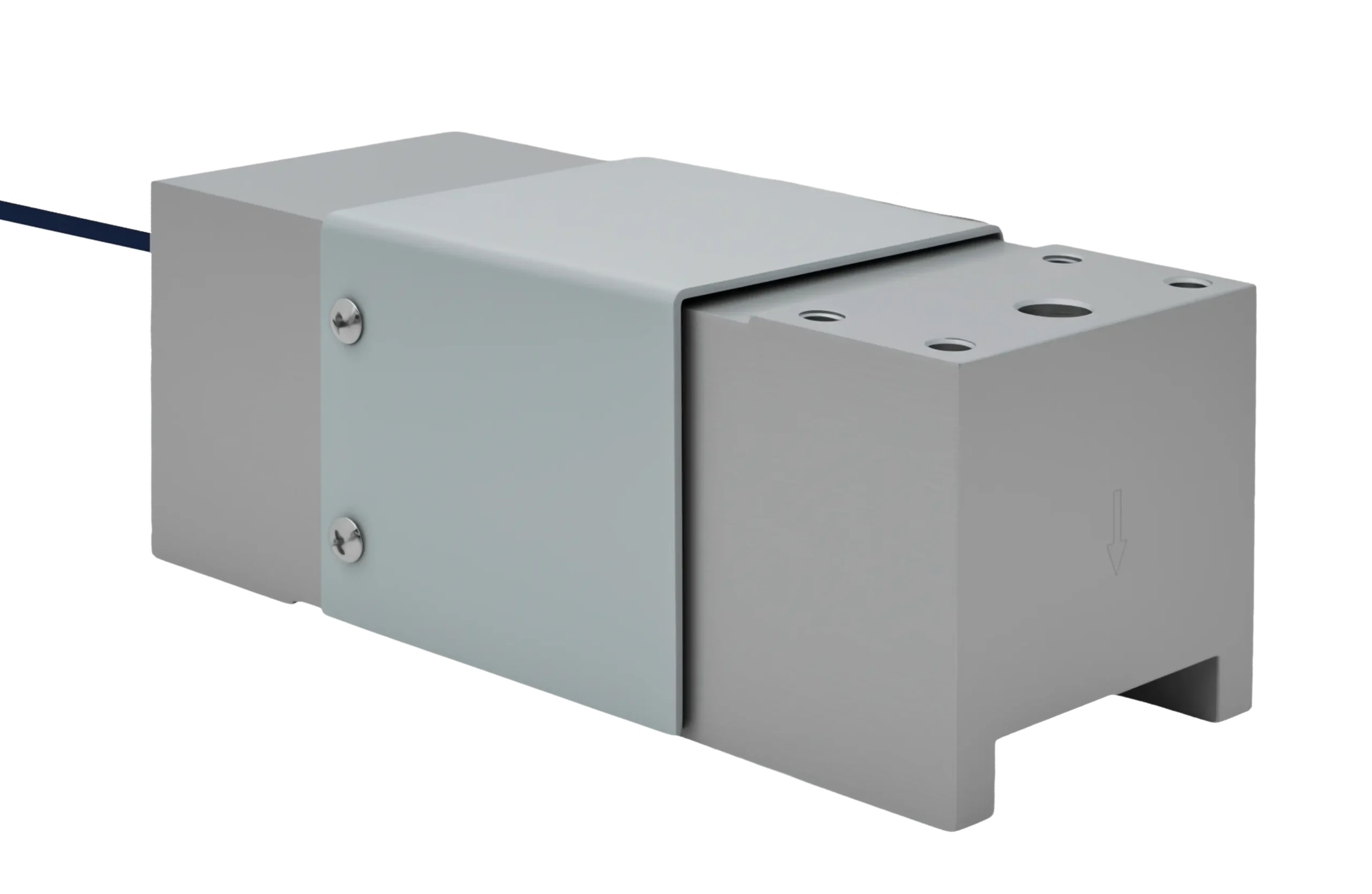
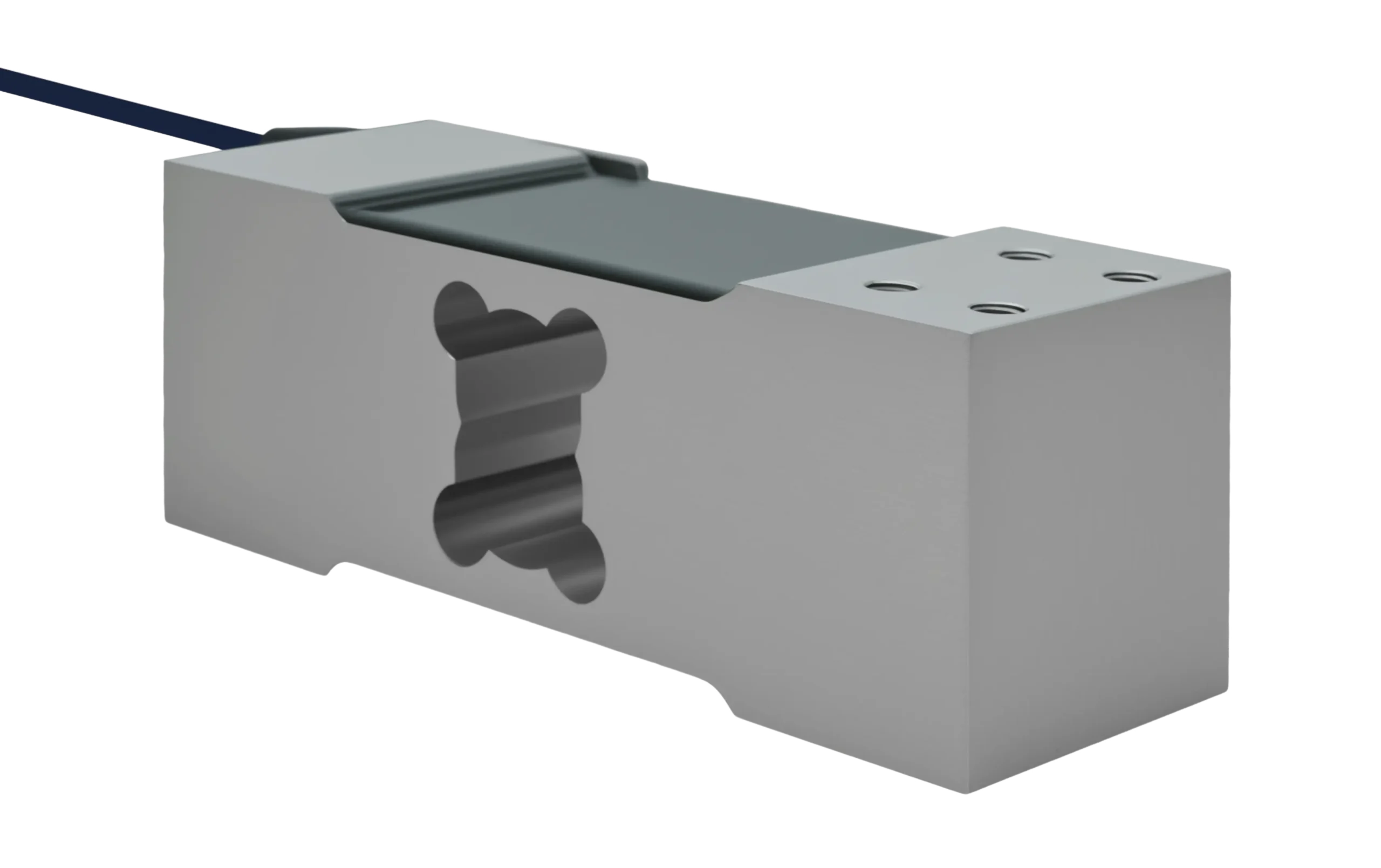
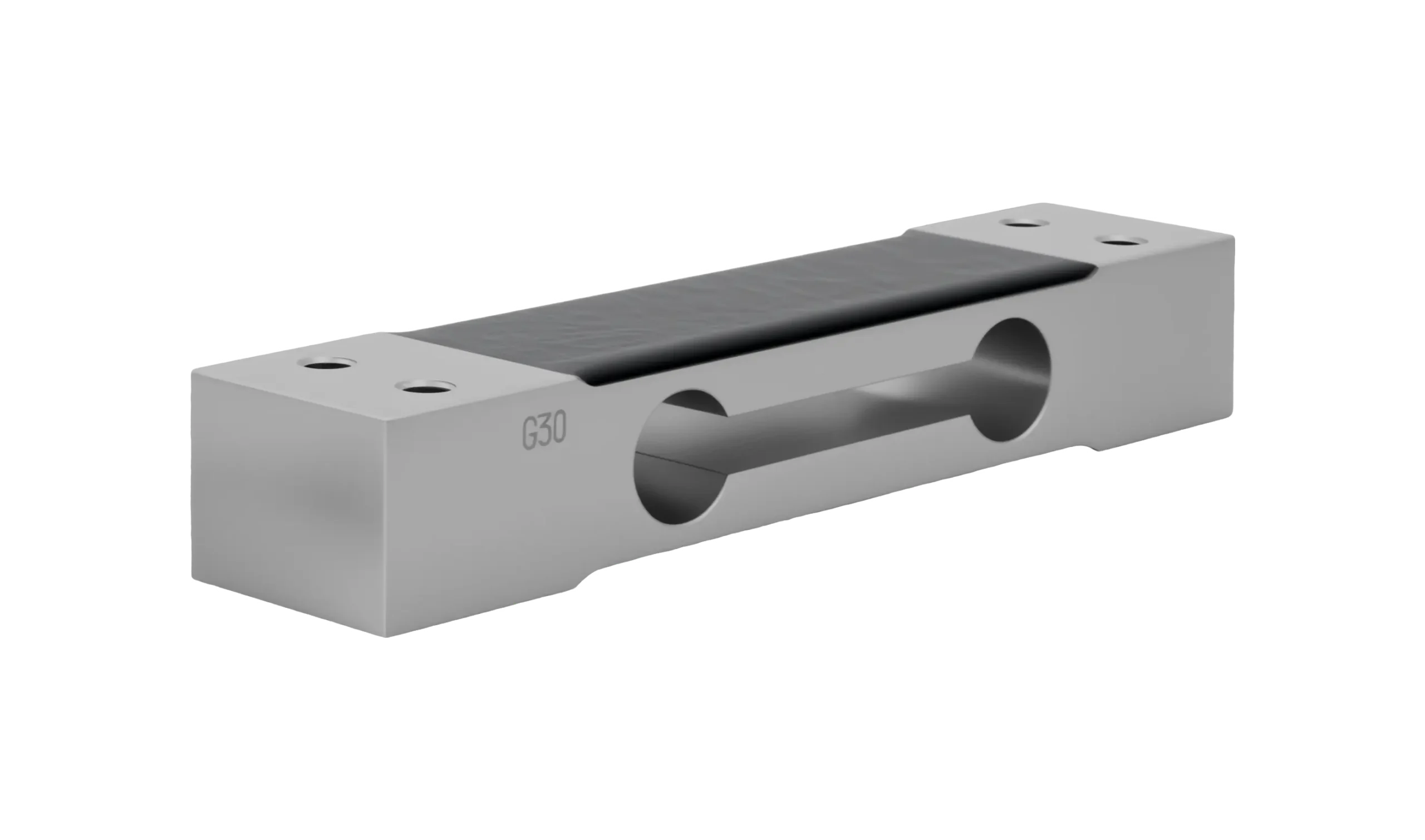
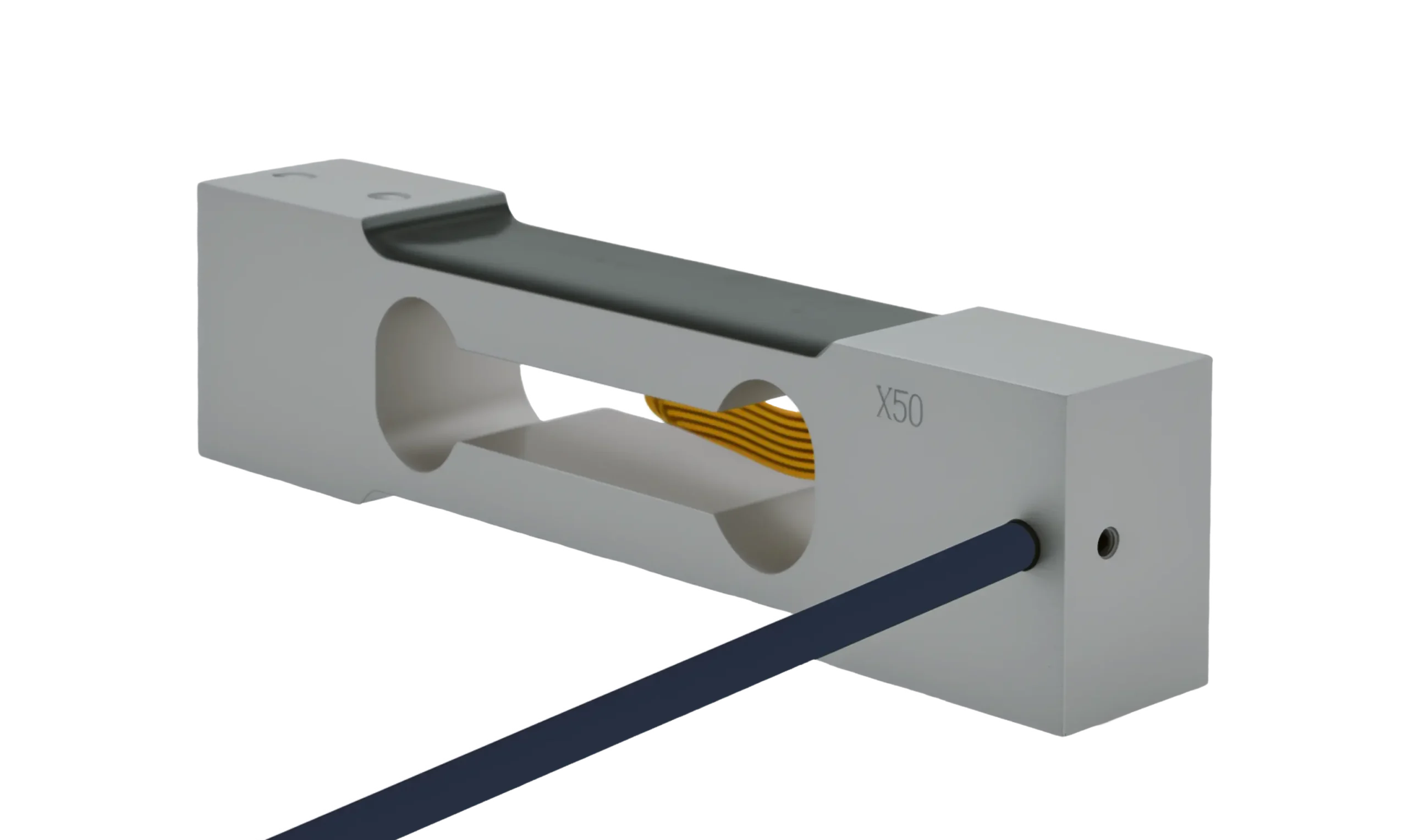
A single point load cell is machined as a parallelogram, and that one geometric choice is what lets a single sensor carry an entire weighing platform and still read the same wherever the load lands on it.
The parallelogram, and why position stops mattering
Put a weight on the corner of a platform carried by an ordinary beam and two things arrive at the sensor: the force you want to measure, and a bending moment produced by the offset. The moment is indistinguishable from load, so the reading changes as the weight moves about the deck.
A single point element is cut so that the sensing section sits between two parallel flexures. Under an off-centre load those flexures deflect by different amounts, and the geometry converts the difference into rotation of the platform rather than into strain at the gauges. What reaches the bridge is the vertical component alone.
The compensation is finished by hand. After machining, material is trimmed from the flexures until the reading at each corner of the rated platform agrees with the reading at the centre. That trimming is the reason a single point costs more to make than a plain bending beam of the same capacity, and it is the entire product.
Go deeper
Why the platform size rating matters as much as the capacity
Corner compensation is trimmed against a specific platform size. The trimming corrects for a known worst-case offset, which is the distance from the load cell centre to the far corner of the rated deck.
Fit a larger platform and that distance grows. The moment grows with it, past what the flexures were trimmed to absorb, and corner readings begin to disagree with centre readings. Nothing breaks and nothing is overloaded, so the failure is quiet: the scale simply stops being accurate in a way that only shows up if you weigh the same object in two places on the deck.
This is why the platform dimension is quoted alongside the capacity, and why it is the first number to check when an existing scale reads inconsistently. The FAY is rated for platforms up to 24 by 24 inches; the smaller families are correspondingly smaller.
One load cell against four
A four-load-cell platform needs a summing junction box, corner trimming in the field, and four cable runs. Each load cell reads its own share of the load and the box adds them, which means each corner has to be balanced against the others after installation.
A single point does all of that in the factory. One cable, no junction box, no field trimming, and a corner error already inside specification when it arrives. For a bench or retail scale that is a decisive simplification, and it is why almost every scale under about 500 kg is built this way.
The trade is size and capacity. Four beams spread the load across a structure and have no inherent platform limit, so above roughly 1,000 kg or beyond the rated deck size, four load cells is the sound answer and a single point is not.
Why almost all of them are aluminium
The parallelogram needs to flex enough for the compensation to work, and it needs to do so repeatably over millions of cycles. Aluminium alloy has a lower modulus than steel, so for a given capacity the section can be more generous while still producing usable strain, which makes the part easier to machine accurately and easier to trim.
Every one of our single point families (FAK, FAS, FASB, FAV and FAY) is aluminium for exactly that reason, and all five carry the same ±0.03% figure for nonlinearity and hysteresis.
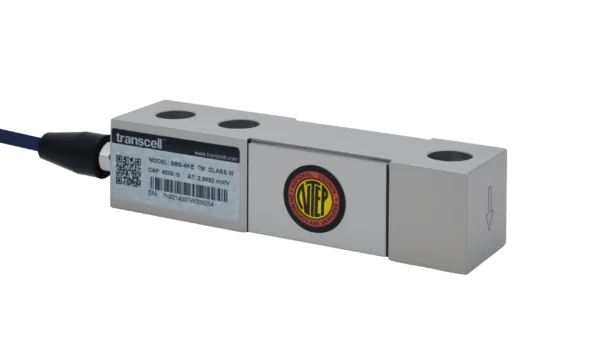
What aluminium does not do is survive washdown or corrosive process environments indefinitely. Where that is the requirement, a hermetically sealed stainless bending beam such as the BSH is the right part even though it gives up the single-load-cell simplicity.