
Cables
On a 4-wire installation the cable is part of the calibration, not just a wire.
Free shipping across the USA.
Not sure which cable?
Cables catalog

Load Cell Cable, 4 Conductor
24 AWG on a 500-foot spool. The bulk cable for a new run or a full replacement.

Spare 14-pin Load Cell Cable
The factory lead for instruments that use the 14-pin connector, supplied made up.
TI-500E Cable, 14-pin, 35 ft
A longer 14-pin assembly where the standard lead will not reach. Also fits many bench scales.

Quick Disconnect Cable
5-pin metal connector, 18 ft in total: a one-foot pigtail and 17 ft on the other side.

NMC-1 RS-232 Cable
The serial lead for the TCS3T counting scale, most indicators and many bench scales.
RS-232 DB9 to DIN Cable
The lead that drives an MP-20 printer from an instrument's serial port.
Custom & OEMWe also build the ones that aren’t in any catalog. Learn more
A cable is one link in a measuring chain. The neighbouring links matter as much.
Most complaints that begin "the scale is unstable" end at the cable, its route or its terminations. These are the parts at each end of it.
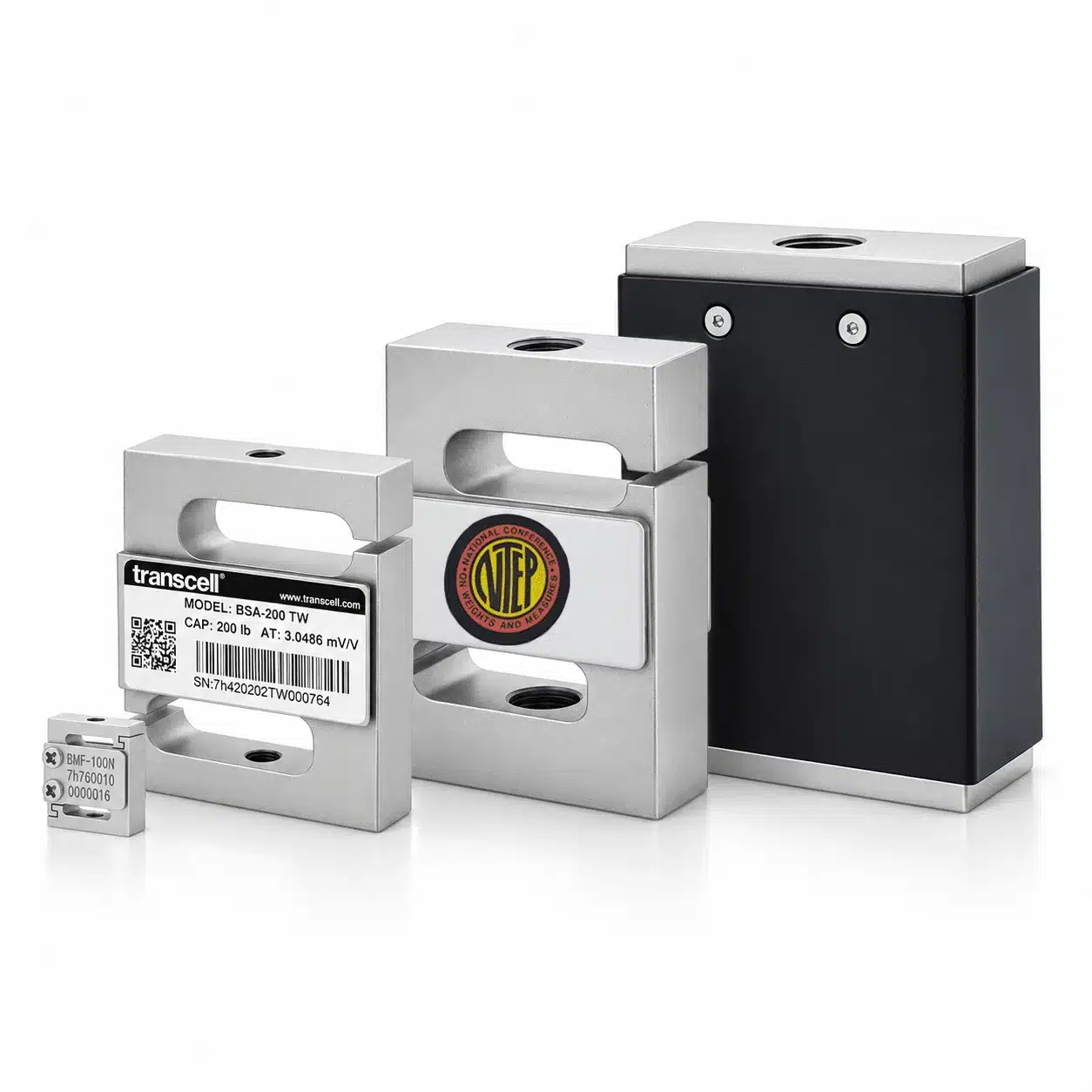
Load Cells
What the cable is carrying a few millivolts from. Twelve families, designed, built and calibrated in the same building.
View products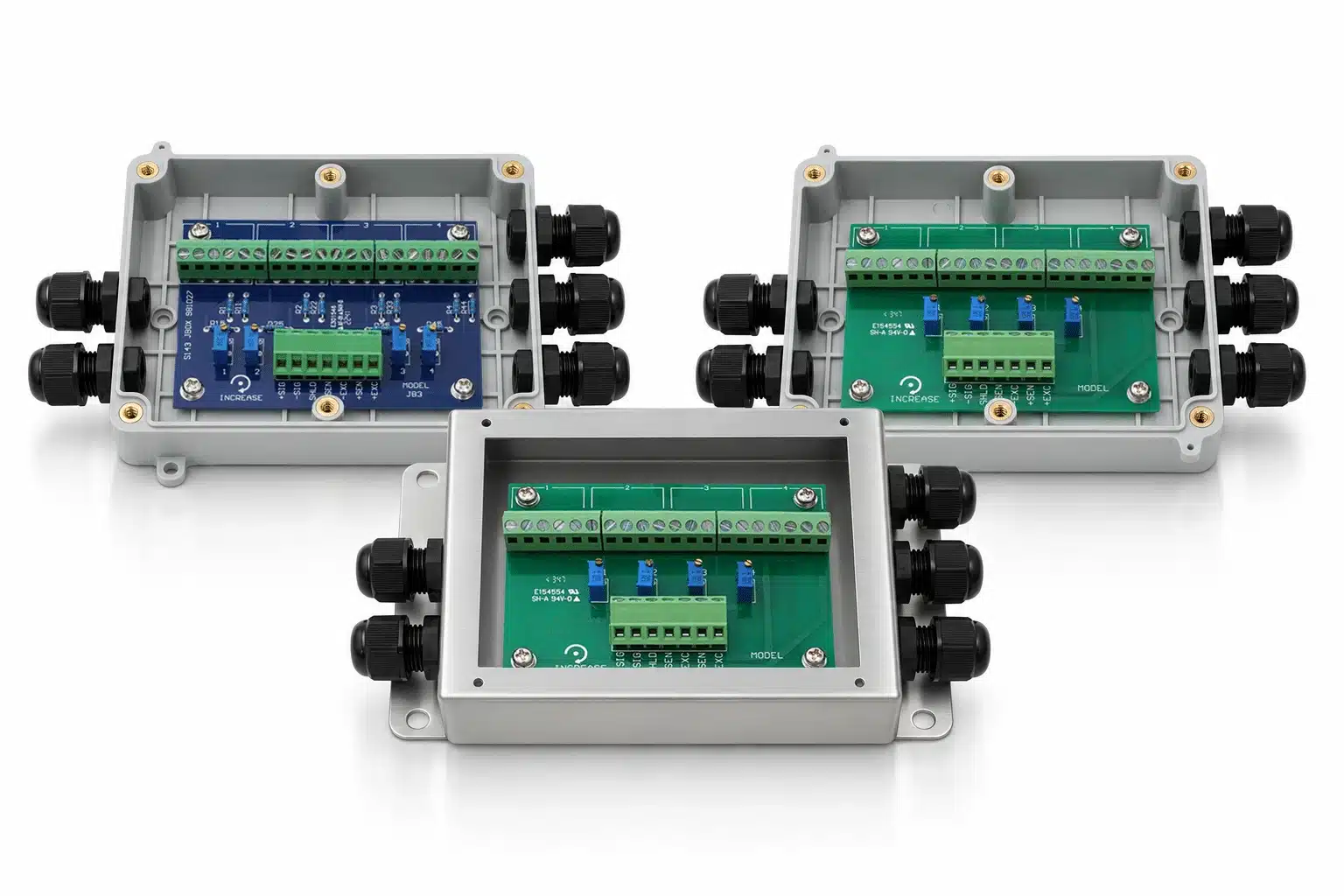
Junction Boxes
Where several load cells are summed and trimmed onto one signal. Also the commonest place a corroding splice hides.
View products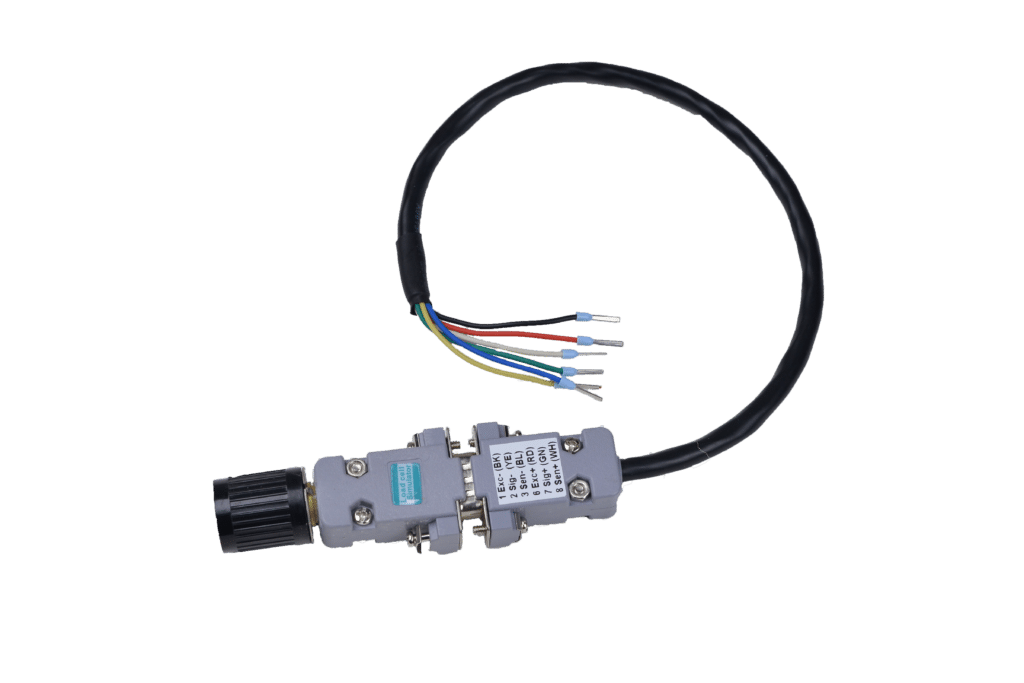
Fixtures & Adapters
The load cell simulator settles whether a fault is in the cable and the load cell, or in the instrument reading them.
View productsWhy Transcell. Ordered like a store, backed like a partner.
Free 2-day shipping
Every USA order ships free in two days, Alaska and Hawaii included, with no minimum purchase.
Ships worldwide
International orders ship at FedEx live rates: what FedEx charges is what you pay.
Warranty backed
Every product ships with a manufacturer warranty, from the people who built the load cell on the other end of the cable.
Custom when you need it
A length, a connector, a gland or a pinout that is not stocked is ordinary assembly work for us rather than a special request.
Load cell cable reference
Cable is the least glamorous part of a weighing system and the source of a surprising share of its problems. Below: when bulk cable is right and when a factory assembly is, what the four conductors are actually doing and why a fifth and sixth exist, a table that turns a situation into a part, the six cables side by side, and the wiring vocabulary a datasheet assumes.
How to choose a cable. Bulk or assembly, first.
The six cables here answer two different questions. One is a spool for building a run; the other five are made-up leads for specific instruments. Getting that split right settles most of the decision, and the reason it matters is electrical rather than practical.
Bulk spool or factory assembly?
This is the decision that costs money when it goes the wrong way, and the reason is not obvious.
On a 4-wire load cell installation the cable's own resistance is part of the calibration. The instrument supplies excitation down two conductors, and the resistance of that copper drops a little of the voltage before it reaches the load cell. Since the load cell's output is proportional to the excitation it actually receives, that drop is baked into the span the day the scale is calibrated. Shorten the cable, and you have changed the resistance and therefore the span.
So do not cut a factory lead to tidy it up. Coil the excess and leave it. If the run genuinely has to be shortened or lengthened, the scale needs recalibrating afterwards, and that is a service visit rather than a five-minute job.
The 500-foot spool at $475 is for building a run from scratch, where the calibration will be done after the cable is in place. The five assemblies exist because their instruments use connectors, the 14-pin and the 5-pin quick disconnect among them, and a connector is not something to crimp on a bench and hope.
The one case where bulk and assembly overlap is a scale being commissioned fresh. There, either works, and the assembly is usually still the better buy because it arrives terminated and tested.
Four wires, or six?
A strain gauge load cell is a four-wire device at heart: two conductors carry excitation out to the bridge, two carry the millivolt signal back. Our bulk cable is 4-conductor, 24 AWG, on a 500-foot spool, which covers standard installations and is what most platform scales are built with.
Six-wire cable adds a sense pair, and it exists for exactly the reason described above. Because copper has resistance, a long excitation run arrives at the load cell at slightly less than the voltage the instrument thinks it is supplying. Sense lines carry almost no current, so they report the voltage actually present at the load cell, and the instrument corrects for the difference.
That correction matters in two situations. The first is distance: the longer the run, the larger the drop. The second is temperature, and it is the one people miss. Copper resistance rises as it warms, so a 4-wire run that is calibrated in a cool morning workshop and then spends the afternoon in the sun will drift, and the drift looks exactly like a scale going out of calibration.
The practical threshold is not a single number, because it depends on gauge, length and how tight the accuracy has to be. The honest guidance is that short indoor runs are comfortably fine on four wires, and that long, outdoor, or precision installations should be specified as six from the start. If yours is near the line, tell us the length and the accuracy you need.
How is the cable routed and grounded?
A load cell returns a few thousandths of a volt. That is a smaller signal than the interference a motor lead induces into anything running beside it, which is why cable routing is not a tidiness question on a weighing system.
Run the signal cable in its own conduit. Where it must cross power wiring, cross at right angles rather than running parallel, because parallel runs couple and perpendicular crossings barely do. Keep the whole route away from variable frequency drives, contactors and welding equipment, which are the three worst offenders in an industrial building.
Ground the shield at one end only, normally at the instrument. This is the rule broken most often, usually with good intentions. Grounding both ends gives interference a complete circuit through the shield, a ground loop, and the resulting current injects exactly the noise the shield was fitted to stop. A scale with a ground loop behaves like a scale with a failing load cell.
A diagnostic worth knowing: if the reading is steady with a nearby drive switched off and wanders when it runs, the fault is the cable route or the grounding, not the load cell. That test takes a minute and saves dismantling a perfectly good scale.
Does anything get disconnected regularly?
A permanently wired instrument and one that comes off the scale weekly are different installations, and the difference should be designed in rather than improvised.
The quick disconnect cable at $50 is built for it: a 5-pin metal connector with a one-foot pigtail on the instrument side and 17 feet on the other, about 18 feet in total. It exists so a stainless indicator can be lifted off a scale base for cleaning without disturbing the wiring, which on a washdown installation happens every shift.
The reason to buy this rather than improvise is that a repeatedly worked joint is where corrosion and intermittent faults begin. A proper connector is designed for the cycle count; a terminal block opened and closed twice a week is not, and the fault it eventually produces is intermittent, which is the hardest kind to trace.
The same logic applies to the 14-pin assemblies. Where an instrument uses that connector, the lead is a stocked part precisely so nobody has to make one up, and the 35-foot version exists for runs the standard lead cannot reach.
Is it a load cell cable or an interface cable?
The page holds two different kinds of cable, and it is worth separating them because they solve different problems.
Measurement cables carry excitation out and millivolts back: the bulk spool, the two 14-pin assemblies and the quick disconnect. Everything above about shielding, grounding and calibration applies to these.
Interface cables carry data at logic levels: the NMC-1 RS-232 lead and the DB9 to DIN lead for the MP-20 printer. These are far more tolerant, because a serial signal swings volts rather than millivolts, and they are the leads that connect an instrument to a printer or a PC.
The NMC-1 is listed for the TCS3T counting scale, most Transcell indicators and many bench scales, which makes it the general-purpose serial lead in the catalog. The DIN cable is specific to the MP-20 printer.
If what you actually need is a port rather than a lead, that is a different page: a second or isolated RS-232 channel is an option module fitted inside the instrument, not a cable.
What the cable is carrying. And where it gets lost.
Five steps between the load cell and the number on the display. Four of them happen inside the cable, which is why so many measurement problems are really cable problems.
01
Excitation out
The instrument supplies a stable 5 to 10 V DC down two conductors. The resistance of that copper drops part of it before it arrives, which is what sense lines exist to correct.
02
Millivolts back
A 2 mV/V load cell at full load returns about 10 mV at 5 V excitation. That is the entire signal, and it is smaller than the noise a motor lead induces into a parallel run.
03
Sense lines, if fitted
The optional third pair carries almost no current, so it reports the voltage actually present at the load cell. The instrument corrects for the drop instead of reading it as weight.
04
Shield and ground
The braid or foil intercepts interference, but only when it is grounded at one end. Grounded at both, it becomes a loop and injects the noise it was fitted to stop.
05
Termination
Junction box, gland, strain relief. A corroding splice in a wet room is the classic intermittent that looks exactly like a load cell beginning to fail.
Two habits prevent most cable-related faults, and both cost nothing: run the signal cable in its own conduit and cross power at right angles, and leave the shield grounded at one end only. If a reading is stable with the plant quiet and wanders when a drive starts, neither habit is being followed.
Which cable do you need? Start from what is failing.
The first four rows are measurement cables and the last three are not, which is the distinction that decides most of this page.
| If you are | Order | Why |
|---|---|---|
| Wiring a new scale, or replacing a run end to end | 4-conductor bulk cable $475 | 24 AWG on a 500-foot spool, cut to whatever the run needs. Calibrate after the cable is in place, because on a 4-wire system its resistance is part of the span. |
| Replacing a lead on an instrument with a 14-pin connector | Spare 14-pin cable $45 | Supplied made up and terminated. A connector is not something to crimp at a bench, and the assembly costs less than the time it saves. |
| Finding the standard 14-pin lead too short | TI-500E cable, 35 ft $100 | The long version of the same assembly, listed for the TI-500E and for many bench scales. Better than extending a lead with a splice. |
| Lifting a stainless indicator off the base to clean | Quick disconnect cable $50 | A 5-pin metal connector with a one-foot pigtail and 17 feet on the other side. Designed for the cycle count that a terminal block is not. |
| Connecting an instrument to a PC or a logger | NMC-1 RS-232 cable $25 | The general-purpose serial lead, listed for the TCS3T counting scale, most indicators and many bench scales. |
| Driving an MP-20 printer | RS-232 DB9 to DIN $25 | The specific lead for that printer's DIN socket. The TDP-225 uses a different arrangement and ships with its own cable. |
| Needing a second or isolated serial port | An option module | Not a cable at all. A port is a card fitted inside the instrument, so it is specified with the indicator rather than added afterwards. |
| Chasing an unstable reading | A load cell simulator | Substitute a known signal for the load cell. If the instrument then reads correctly, the fault is in the load cell, the cable or the junction box, and you have halved the search. |
| Summing several load cells before the instrument | A junction box | Cable alone does not sum. The load cells are paralleled and trimmed in a box so a corner load reads the same anywhere on the platform. |
The six cables, side by side. Four carry a measurement, two carry data.
Lengths and constructions are as published on each product page. Where a specification is not published, the row says so rather than estimating.
| Cable | Price | SKU | What it is | Use it for |
|---|---|---|---|---|
| Measurement cable | ||||
| Load Cell Cable, 4 conductor | $475 | P3271059153TW | 24 AWG, 4 conductors, shielded, 500 ft spool. | New runs and full replacements on 4-wire installations |
| Spare 14-pin Load Cell Cable | $45 | P327061465TW | Factory assembly, 14-pin connector. 15 ft, shielded. | Replacing the load cell lead on instruments using the 14-pin connector |
| TI-500E Cable, 14-pin | $100 | P327061106TW | Factory assembly, 35 ft, 14-pin connector | Longer runs on the TI-500E, and listed for many bench scales and indicators |
| Quick Disconnect Cable | $50 | 327061601 | 5-pin metal connector. 1 ft pigtail plus 17 ft, about 18 ft total | Stainless indicators that come off the scale base for cleaning |
| Interface cable | ||||
| NMC-1 RS-232 Cable | $25 | P380190048 | Serial interface lead. 9-pin D-sub at each end, wired null modem (crossover) for a PC COM port. | TCS3T counting scale, most Transcell indicators, many bench scales |
| RS-232 DB9 to DIN Cable | $25 | 380970016 | DB9 to DIN serial lead | Driving the MP-20 printer from an instrument's serial port |
The bulk spool is the only item here sold by length rather than as a finished assembly, and it is the only one where the installer decides the run. That is also why it is the only one where calibration afterwards is not optional: on a 4-wire system the length you cut becomes part of the scale's span.
Cable terms, in plain language. What they mean when you're specifying.
Show all 20 terms
- 4-wire cable
- Two conductors carrying excitation out to the load cell and two carrying the millivolt signal back. The standard arrangement, and what the bulk spool here is.
- 6-wire cable
- Adds a sense pair so the instrument can measure the voltage actually arriving at the load cell and correct for the drop in the run.
- Sense lines
- The extra pair itself. They carry almost no current, which is precisely why they report excitation at the load cell rather than at the instrument.
- Excitation
- The stable voltage the instrument supplies to the load cell bridge, commonly 5 to 10 V DC. The load cell's output is proportional to it.
- mV/V
- A load cell's rated output per volt of excitation. A 2 mV/V load cell at 5 V excitation returns about 10 mV at full load, which is the whole signal.
- AWG
- American Wire Gauge, the conductor size. Lower numbers are thicker and drop less voltage per foot. The bulk cable here is 24 AWG.
- Shield
- A foil or braid wrapped around the conductors that intercepts electrical interference before it reaches the signal pair.
- Drain wire
- A bare conductor in contact with a foil shield, there so the shield can be grounded without trying to clamp foil in a terminal.
- Single-point ground
- Grounding the shield at one end only, normally the instrument. Grounding both ends creates a loop and injects the noise the shield was fitted to prevent.
- Ground loop
- A current circulating in the shield because its two ends sit at different potentials. On a scale it produces symptoms identical to a failing load cell.
- Voltage drop
- The loss along a conductor caused by its own resistance. It grows with length and with temperature, which is why long or outdoor runs favour 6-wire cable.
- Span
- The scale factor between the load cell's output and displayed weight. On a 4-wire installation the cable's resistance is part of it, so changing the cable changes the span.
- Strain relief
- The gland or clamp that takes mechanical load off the conductors where a cable enters an enclosure, so the strain is on the jacket rather than the joints.
- Gland
- The fitting that seals a cable where it passes through an enclosure wall, and what an IP rating depends on at that point.
- Pigtail
- A short length of cable pre-attached to a connector or an instrument, like the one-foot tail on the quick disconnect.
- Quick disconnect
- A connector designed to be mated and unmated repeatedly, for installations where the instrument is removed regularly.
- Junction box
- Where several load cells are paralleled onto one signal and trimmed. Also, in practice, where most corroded splices are found.
- Trimming
- Adjusting each load cell's contribution in the junction box so an off-centre load reads correctly, done at commissioning.
- RS-232C
- The point-to-point serial standard fitted to every Transcell indicator. What the NMC-1 and DIN cables carry.
- Interface cable
- A lead carrying data at logic levels rather than a measurement in millivolts, and correspondingly far more tolerant of routing.
Cables, answered.
Can I cut a factory load cell cable to shorten it?
Not without recalibrating the scale afterwards. On a 4-wire installation the cable's own resistance is part of the calibration, because it drops part of the excitation before it reaches the load cell and the load cell's output is proportional to the excitation it actually receives. Shorten the cable and you have changed the span. If the lead is longer than you need, coil the excess and leave it alone.
What is the difference between 4-wire and 6-wire cable?
Six-wire adds a sense pair. Those two extra conductors carry almost no current, so they report the voltage actually arriving at the load cell rather than the voltage the instrument thinks it is sending, and the instrument corrects for the difference. It matters on long runs, where the drop is larger, and on runs that see a wide temperature swing, because copper resistance rises as it warms and a 4-wire system reads that drift as weight.
Does load cell cable need to be shielded?
Yes. Shielding is not optional on a load cell run, so confirm the construction with us before ordering for a new installation, particularly one anywhere near drives or contactors.
Can I run load cell cable in the same conduit as power wiring?
No, and this is the commonest cause of an unstable reading. The load cell returns a few millivolts, which is far smaller than the interference a motor lead induces into a cable running beside it. Give the signal cable its own conduit, cross power at right angles where you have to cross it, and keep the route away from variable frequency drives, contactors and welding equipment.
Should the shield be grounded at both ends?
No, one end only, normally the instrument. Grounding both ends gives interference a complete circuit through the shield, which is a ground loop, and the current that flows injects exactly the noise the shield was fitted to stop. A scale with a ground loop behaves so much like a scale with a failing load cell that it is worth checking the grounding before condemning anything.
How do I know if my problem is the cable or the load cell?
Use a load cell simulator. It substitutes a known, stable bridge signal for the real load cell, so if the instrument reads correctly on the simulator the instrument is fine and the fault is downstream in the load cell, the cable or the junction box. It is the fastest single test on a service call and it is listed under Fixtures and Adapters.
Can I join two cables to make a longer run?
It is possible and it is usually a bad idea. A splice in a wiring box is where corrosion starts, and a corroding joint in a wet room produces an intermittent fault that is far harder to find than a cable that simply fails. If the run needs to be longer, run a single length, or use the 35-foot assembly where the connector allows it. If neither works, we make custom lengths.
Which cable connects my indicator to a printer?
For the MP-20, the DB9 to DIN cable. For most other combinations the NMC-1 RS-232 lead is the general-purpose answer, and it is listed for the TCS3T counting scale, most Transcell indicators and many bench scales. The TDP-225 thermal printer is a special case because it ships with its own RS-232 cable and a 9 V adapter in the box.
I need a second serial port. Is that a cable?
No, that is a module fitted inside the instrument, and it is listed under Indicator Accessories rather than here. RS-232C is already standard on every Transcell indicator, so if you only need one connection you need a lead. The modules add a second channel or an isolated one, and they are specified with the indicator rather than added later.
Can you make a cable to my drawing?
Yes. Lengths, connectors, glands, jacket materials and pinouts are standard modification work here, and private-label and OEM assemblies are a core part of the business. Send the drawing, or send the old cable and tell us what changed.
We Make Your Challenge Our Business
Tell us what it has to do and we’ll tell you what it takes.