
Counting Scales
One scale, four capacities, one price. Capacity sets the smallest part you can count.
Free shipping across the USA.
Not sure which capacity?

A counting scale answers “how many”. These answer the other questions.
The TCS3T arrives complete: platform, keypad, three displays, and a battery so it can sit away from an outlet. Nothing here is a part it is missing. These are the neighboring jobs a counting scale is the wrong tool for.

Shipping Scales
When the answer is pounds rather than pieces, and it has to reach UPS WorldShip or FedEx Ship Manager over USB or RS-232.
View products
TDP-225 Thermal Printer
Puts the count on paper or on a bin label, so an inventory number leaves the bench without being copied by hand.
Shop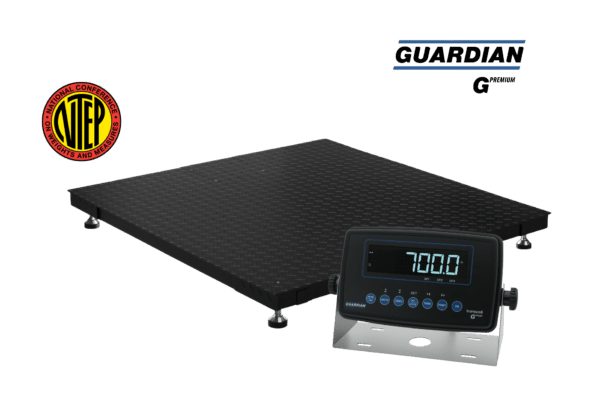
Platform Scales
For counting a quantity too heavy for a bench. A floor scale plus a known piece weight counts the same way, on a pallet.
View productsWhy Transcell. Ordered like a store, backed like a partner.
Free 2-day shipping
A bench counting scale ships as a parcel, so it goes free in two days anywhere in the USA with no minimum order.
Ships worldwide
International orders ship at published rates from Buffalo Grove, Illinois, with the export paperwork handled at this end.
Warranty backed
Covered by warranty and supported from the US, by the people who build the load cells inside it.
Custom when you need it
A capacity, platform size or output that is not on the menu is ordinary work for us rather than a special request.
Counting scale reference
A counting scale is the one scale in this catalog that does arithmetic rather than just weighing, and understanding that arithmetic is the whole of using it well. Below: how to pick a capacity when all four cost the same, what actually happens when you press the sample key, a table that turns a part into a model, the full specification, why a count can be wrong when the weight is right, and the vocabulary on the datasheet.
How to choose a counting scale. Really only one question.
There is a single product on this page in four capacities, and all four cost $500. That removes price from the decision entirely and leaves one thing to get right, which is the capacity. Getting it wrong in the generous direction is the common mistake, and it is the expensive one.
Which capacity, when they all cost the same?
Because the price is flat at $500 across all four models, the instinct is to take the 60 lb and be safe. On a counting scale that instinct is backwards, and it is worth understanding why before you order.
A counting scale works by dividing a total weight by the weight of one piece. Its ability to count small parts therefore depends on how finely it can resolve weight, and that resolution is a fraction of capacity, not an absolute figure. The TCS3T works with more than 300,000 internal counts, so the internal resolution is roughly capacity divided by 300,000. On the 6 lb model that is about 0.009 g. On the 60 lb model the same 300,000 counts are spread across ten times the range, so it is about 0.09 g.
That tenfold difference is the whole decision. It sets the smallest part the scale can count reliably: a tiny screw, an o-ring or an SMD component needs the 6 lb model, while the 60 lb model would be counting in steps far coarser than the part itself weighs and would produce confident nonsense.
So work in this order. Find the heaviest full container you will ever put on the scale, including the bin, and pick the smallest capacity above it. Then check that your lightest part is comfortably heavier than that model's resolution. If those two requirements fight each other, the honest answer is two scales rather than one compromise, and at $500 each that is a smaller decision than it sounds.
What do the three displays actually show?
Most bench scales have one display. The TCS3T has three backlit LCD displays, and the reason is that a count is a derived figure with two inputs, both of which you need to be able to see.
Total weight is what the load cell measured. Average piece weight, usually shortened to APW, is what the scale either learned from a sample or was told from the keypad. Count is simply the first divided by the second.
Having the APW on permanent display is the feature that matters, and it is not obvious until something goes wrong. If a count looks implausible, the fault is almost never the weighing; it is the piece weight. A visible APW lets an operator notice that the scale is dividing by a figure from a different part number before a wrong quantity is written into inventory. On a scale that only shows the count, the same error is silent.
The 20-key numeric keypad exists for the same reason: once a part's APW is known and trusted, it can be typed in directly rather than re-sampled, which is both faster and more repeatable than sampling afresh every time.
Where will it sit, and does it need an outlet?
Two specifications on this scale exist purely because of where counting actually happens, which is rarely a quiet office.
Vibration resistance is the first. A stock room bench near a conveyor, a compressor or a busy aisle is a moving surface, and a scale trying to resolve to a fraction of a gram on a moving surface will hunt endlessly and never settle. The TCS3T filters for this so it can hold a stable reading in a disturbed environment rather than needing an isolated table.
Battery operation is the second. It runs from a rechargeable battery or an AC adapter, so the scale can be carried to the parts instead of the parts being carried to the scale. For cycle counting, where the scale moves along the racking, that is the difference between a workable process and an extension lead.
The footprint is 13.5 × 11.8 × 3.9 in, or 343 × 300 × 99 mm, so it occupies about the same bench space as a sheet of paper.
From a handful to a number. What happens when you press sample.
This is the only scale in the catalog that does arithmetic on your behalf, and every counting error traces back to one of these five steps. Reading them once makes the difference between trusting a count and checking it.
01
You put a known quantity on
Ten pieces, or twenty, or fifty. This is the sample, and it is the single most important thing you will do with the scale, because everything after it inherits whatever error is in it.
02
The scale weighs the sample
One load cell under the platform, the same arrangement as any bench scale. At this point the scale knows a weight and a quantity, and nothing else.
03
It divides to find one piece
Sample weight divided by sample count gives the average piece weight. Averaging is what makes the method work at all, because no two manufactured parts weigh exactly the same.
04
You tip in the rest
Now the scale weighs the full container and divides that total by the piece weight it just learned. The division is trivial; the accuracy was decided in step one.
05
The count appears, with its inputs
All three numbers stay visible: total weight, piece weight, count. If the count is wrong, one of the first two will show you why.
The consequence worth carrying away: a counting scale is never more accurate than its sample. Doubling the sample size roughly halves the effect of piece-to-piece variation on the average, which is why sampling twenty is meaningfully better than sampling five, and why a trusted piece weight is worth typing in rather than re-learning.
Which capacity to order. Set by the biggest bin and the smallest part.
All four rows are the same price, so nothing here is an upsell. The last two rows point off this page, because counting is not always the right tool.
| If you are counting | Order | Why |
|---|---|---|
| Very small parts: screws, o-rings, terminals, small moldings | TC3T-6LB $500 | The finest resolution of the four, around 0.009 g internally, because 300,000 counts are spread across the smallest range. This is the model for parts that weigh a fraction of a gram. |
| Small hardware in moderate quantities | TC3T-12LB $500 | Twice the batch size with half the resolution of the 6 lb. The usual choice when a full bin will not fit inside 6 lb but the parts are still light. |
| Medium components, fuller containers | TC3ST-30LB $500 | Where the container starts to be the constraint rather than the part. Note the model prefix changes at this capacity, from TC3T to TC3ST. |
| Heavier parts or large batches | TC3ST-60LB $500 | The largest batch and the coarsest resolution, around 0.09 g internally. Correct for substantial parts, wrong for tiny ones, and it is the model chosen by mistake most often. |
| A batch too heavy for any bench scale | A platform scale | Counting on a pallet works exactly the same way: total weight divided by a known piece weight. It just needs a floor scale under it and the piece weight established elsewhere. |
| Pounds, not pieces, for a shipping label | A shipping scale | If the number is going to a carrier rather than to inventory, you want weight with a USB or RS-232 output to WorldShip, not a count. |
The TCS3T, line by line. One product, four capacities, one price.
The only rows that change between the four models are capacity, resolution and the part number. Everything else is common, which is why this table is mostly a single column.
| Specification | TCS3T Series |
|---|---|
| Capacity and resolution | |
| Price | $500, every capacity |
| Capacities | 6, 12, 30 and 60 lb |
| Models | TC3T-6LB, TC3T-12LB, TC3ST-30LB, TC3ST-60LB |
| Internal resolution | More than 300,000 counts |
| Resolution at 6 lb | About 0.009 g internally |
| Resolution at 60 lb | About 0.09 g internally |
| Displayed division | 0.0002 lb at 6 lb, 0.0005 at 12, 0.001 at 30, 0.002 at 60 |
| Counting | |
| Method | Sample a known quantity, or key in a known piece weight |
| Displays | Three backlit LCD: weight, piece weight, count |
| Keypad | 20-key numeric |
| Piece weight entry | From a sample or from the keypad |
| Environment and power | |
| Vibration resistance | Filtered to hold a stable reading on a disturbed bench |
| Power | Rechargeable battery or AC adapter |
| Dimensions | 13.5 × 11.8 × 3.9 in |
| Ordering | |
| SKUs | 104520710TW, 104520720TW, 104520730TW, 104520740TW |
| Product type | Variable: capacity is a model menu |
| Datasheet | TCS3T (PDF) |
| Shipping | Free 2-day, no minimum |
| Serial output | RS-232, to a serial printer |
| Legal for trade | Not NTEP certified |
| Warranty | 1 year limited |
Order by capacity: the 6 and 12 lb models carry the TC3T prefix and the 30 and 60 lb models TC3ST, all four from the same TCS3T Series.
Why a count can be wrong. When the weight is perfectly right.
Every failure mode of a counting scale lives in the piece weight rather than in the weighing. These are the six that account for almost all of them, and all six are avoidable.
| What goes wrong | What to do about it | Why it happens |
|---|---|---|
| The sample was too small | Sample twenty pieces rather than five | The average piece weight inherits the variation of whatever you sampled. A small sample can be unrepresentative by chance, and that error is then multiplied across the whole container. |
| The parts are not consistent | Sample from several places in the batch | Castings, moldings and anything with flash vary more than machined parts. If piece weight genuinely varies a lot, counting by weight has a floor on its accuracy that no technique removes. |
| The parts are too light for the model | Move to a lower capacity | If one piece weighs less than a few times the scale's resolution, the count cannot be trusted. This is the 60 lb model being used for 6 lb work. |
| The container was not tared | Tare the empty bin first, every time | The bin's weight otherwise reads as parts. A heavy tote can add hundreds of phantom pieces, and the count will look entirely plausible. |
| The piece weight is left over | Check the middle display before trusting the count | The scale keeps dividing by the last piece weight it was given, including one from a different part number. This is the single most common counting error and the reason the APW is on permanent display. |
| The bench is moving | Let it settle, or move the scale | Vibration resistance buys a lot of tolerance but not infinite tolerance. A reading that will not stabilise is telling you something about the surface, not about the parts. |
A habit that catches nearly all of these: after sampling, put a known quantity back on and confirm the scale reports it. Ten pieces should read ten. It takes five seconds and it verifies the piece weight, the tare and the resolution in one action.
Counting scale terms, in plain language. What they mean when you're specifying.
Show all 20 terms
- Counting scale
- A bench scale that reports a quantity instead of a weight, by dividing the total weight on the platform by the weight of one piece.
- Average piece weight
- The weight of a single item, worked out by weighing a known quantity and dividing. Usually shortened to APW, and it is the number every count depends on.
- APW
- The usual abbreviation for average piece weight. On the TCS3T it has a display of its own, so an operator can see what the scale is dividing by.
- Sampling
- Placing a known quantity on the scale and telling it how many there are, so it can calculate the average piece weight. The accuracy of everything afterwards is set here.
- Sample size
- How many pieces you use to establish the piece weight. Larger samples average out piece-to-piece variation, which is why twenty is better than five.
- Internal resolution
- How finely the scale measures internally, before rounding for display. The TCS3T works with more than 300,000 internal counts, which is far finer than what it shows.
- Internal counts
- The number of steps the scale divides its capacity into internally. Because it is a division of capacity, the same count total gives finer resolution on a lower-capacity model.
- Displayed division
- The increment the display actually moves in, which is coarser than the internal resolution. The internal figure is what governs counting; the displayed one is what you read.
- Minimum piece weight
- The lightest single item a given model can count dependably. It scales with capacity, which is the reason not to buy more capacity than you need.
- Tare
- Subtracting the weight of the container so only the contents are weighed. On a counting scale an untared bin becomes phantom pieces, and the count still looks believable.
- Load cell
- The sensing element that turns force into a small electrical signal. A bench counting scale uses one, under the center of the platform.
- Vibration resistance
- Filtering that lets the scale settle on a stable reading despite a bench that is moving. Necessary at this resolution in any real stock room.
- Stable reading
- The point at which the scale decides the weight has settled and can be used. Counting from an unsettled reading is how a plausible wrong number gets recorded.
- Backlit LCD
- A display lit from behind so it stays readable in a dim stock room or under racking, where a reflective display would not be.
- Cycle counting
- Auditing inventory a section at a time rather than all at once. It is the main reason a counting scale needs to run on a battery: the scale goes to the parts.
- Piece count
- The output number: how many items are on the platform. Derived, not measured, which is the distinction that matters when one looks wrong.
- Accumulation
- Adding successive counts into a running total, so a quantity larger than the platform holds can be counted in several passes.
- Checkweighing
- Comparing each reading against a target with a tolerance either side, so the scale signals over, under or acceptable rather than only reporting a figure.
- Legal for trade
- Approved for use where the weight is the basis of a commercial transaction. Relevant here only if you sell parts by counted quantity derived from weight.
- Variable product
- A single catalog item with a menu of models, which is how the four TCS3T capacities are sold, and why a capacity has to be chosen on the product page rather than here.
Counting scales, answered.
All four capacities cost $500, so should I just buy the 60 lb?
No, and this is the one thing worth getting right on this page. A counting scale resolves weight as a fraction of its capacity, so the 60 lb model spreads the same 300,000 internal counts across ten times the range as the 6 lb model, giving roughly 0.09 g of internal resolution instead of 0.009 g. Extra capacity you do not need is resolution you have thrown away, and it shows up as unreliable counts on small parts. Pick the lowest capacity that still holds your fullest container.
How does a counting scale actually know how many pieces there are?
It does not count them; it divides. You put a known quantity on the platform and tell it how many, it works out the average weight of one piece, and from then on it divides total weight by that figure. Everything about accuracy follows from that: the count is only as good as the piece weight, and the piece weight is only as good as the sample it came from.
How many pieces should I use for a sample?
More than feels necessary. Twenty is a reasonable default and is meaningfully better than five, because a larger sample averages out the variation between individual parts. If the parts vary a lot, castings and moldings especially, take the sample from several places in the batch rather than a handful off the top.
Why does it have three displays?
Because a count is a derived number with two inputs, and you need to see all three. Total weight is what was measured, average piece weight is what the scale is dividing by, and count is the result. The middle one is the useful one: when a count looks wrong, the piece weight is almost always the reason, and having it on permanent display is what lets an operator catch a leftover value from a different part before a wrong quantity is recorded.
What is the smallest part it can count?
It depends on which capacity you bought, which is exactly why the capacity choice matters. As a rule the single piece needs to weigh comfortably more than the scale's resolution, so the 6 lb model at roughly 0.009 g internally handles much smaller parts than the 60 lb at roughly 0.09 g. If your parts are near that limit, drop a capacity.
Can I type in a piece weight instead of sampling?
Yes, and for a part you count regularly it is the better habit. The 20-key numeric keypad is there for it. A piece weight that has been established carefully once and recorded is more repeatable than sampling fresh each time, and it removes the commonest source of error.
Does it need to be plugged in?
No. It runs on a rechargeable battery as well as an AC adapter, which is what makes cycle counting practical: the scale travels to the racking instead of the parts traveling to the bench. The vibration resistance is there for the same reason, so it still settles on a moving surface.
Is the TCS3T legal for trade?
No. The TCS3T is not NTEP certified, so a count from it cannot be the legal basis of a commercial transaction. That is normal for a counting scale, which is built to answer how many rather than to sell by weight. If the number has to be legal for trade, a certified bench or platform scale is the right tool and we can point you at one.
Can it send the count to a PC or a printer?
Yes. The datasheet lists an RS-232 port for a serial printer, and the accumulator can total either pieces or weight and print that total. A printer on RS-232 is the usual way to get a count onto a bin label.
Can you supply a capacity or platform that is not listed?
Yes. Custom capacities, platform sizes and outputs are normal work for us, and we manufacture the load cells and electronics ourselves rather than reselling somebody else's. Tell us the part you are counting, the container it arrives in, and where the number has to go.
We Make Your Challenge Our Business
Tell us what it has to do and we’ll tell you what it takes.