
Wireless Scales
Complete scales, portable beams, and kits to convert the scale you already own.
No cable between the deck and the readout.
Not sure which kind?
Wireless scale models and RF conversion kits

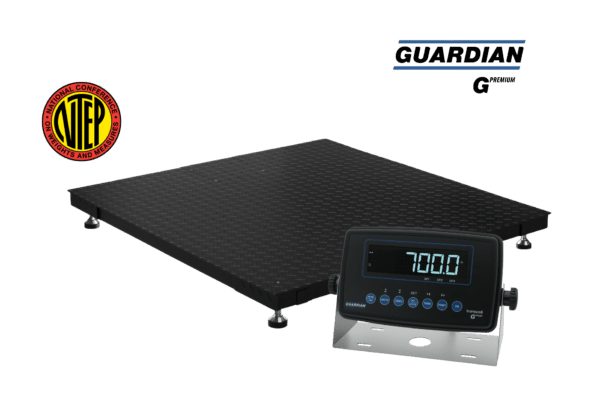
Guardian Premium RF 4 × 4 ft
The washdown G-700K, RF kit included and pre-configured. NTEP at 5,000 and 10,000 lb for the same price.
Guardian Premium RF 5 × 5 ft
60 × 60 in of deck for oversized or badly aimed loads. Otherwise identical to the 4 × 4.
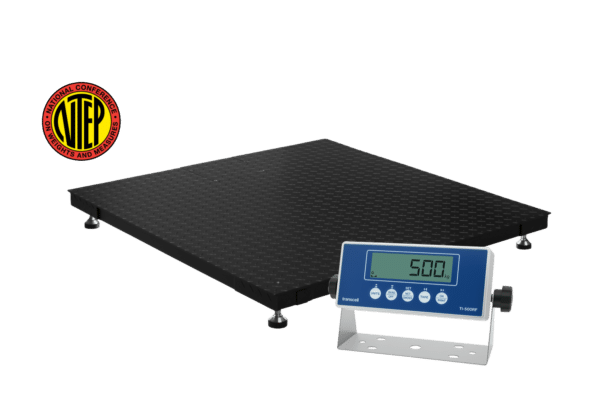
Guardian 4 × 5 ft, TI-500 RF
The one footprint the Premium does not offer: 48 × 60 in. Buy it for the deck size, not the features.
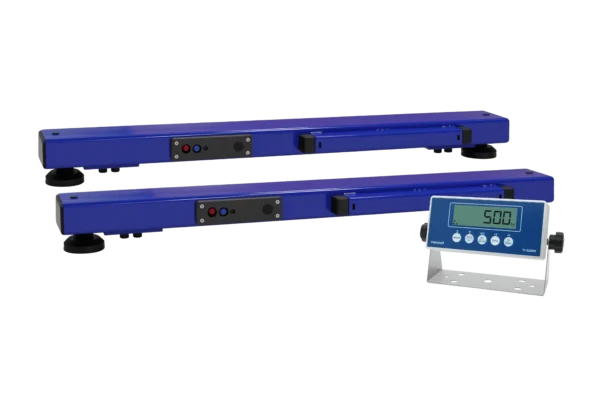
WB5040-AWP weigh beams
No floor scale at all. Two Bluetooth beams that slide under the load at 3.7 in and pack up again.

WB5040-SWP weigh beams
The same beams with the stainless NEMA 4X readout, for washdown, chemicals and food.

RF Kit Alpha XR
Converts a wired scale you already own. Aluminum indicator plus a single-channel RF module, internal antenna.

RF Kit Delta XR
The same conversion with a stainless steel indicator, for a washdown or corrosive area.

RF Kit Foxtrot XR
Stainless again, but with an external antenna. The one to pick when the module has to sit inside metal.
Custom & OEMWe also build the ones that aren’t in any catalog. Learn more
Wireless removes one cable. These are the parts either side of it.
The complete scales here arrive calibrated and ready, and the RF kits include both halves of the wireless link. Nothing below is a missing part. These are the related decisions the wireless choice tends to raise.
Platform Scales
The wired versions of the same platforms, several hundred dollars cheaper. Worth comparing before paying for RF you may not need.
View products
TDP-225 Thermal Printer
A wireless scale still needs the weight to leave the indicator. RS-232 to paper, ticket or bar code label.
Shop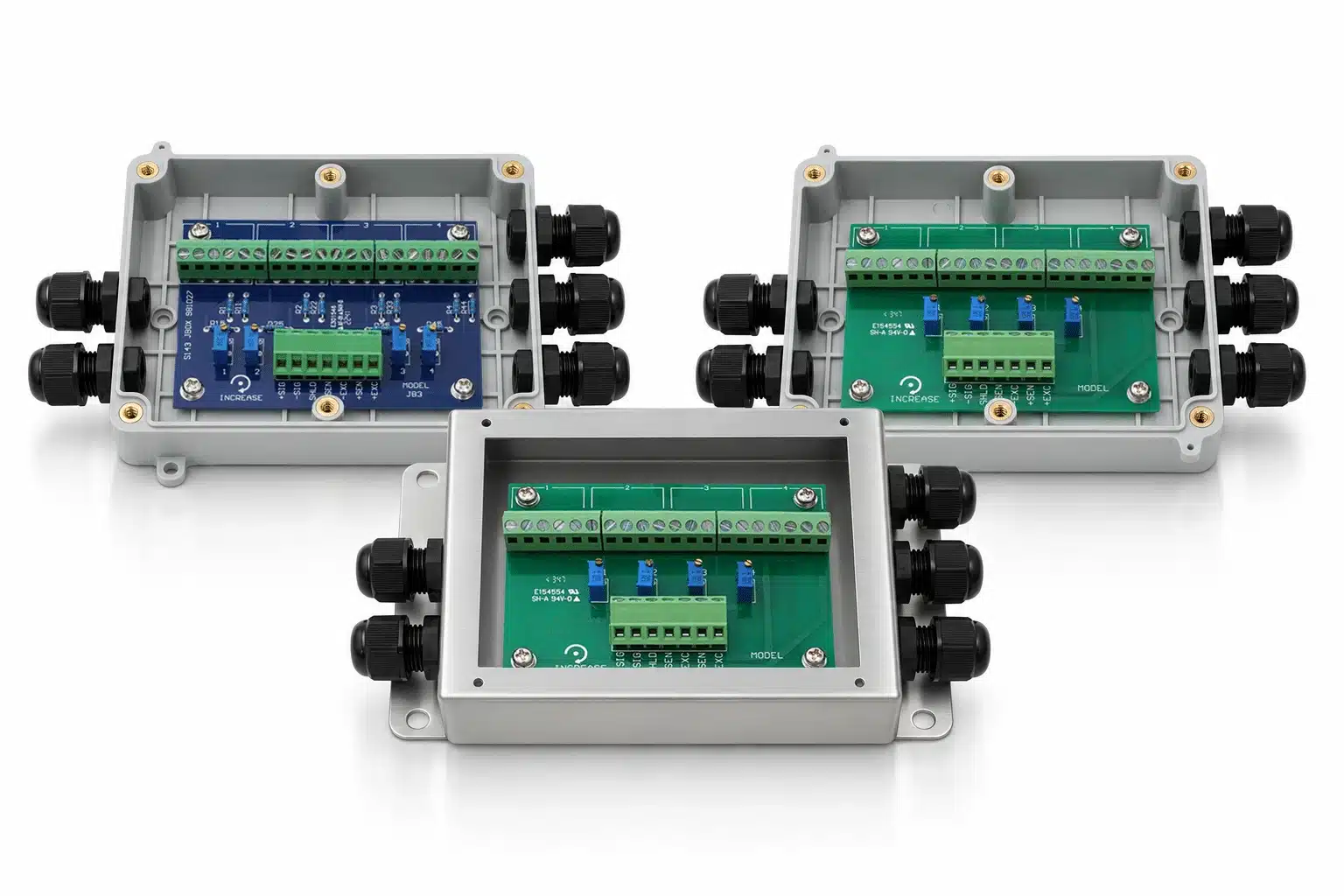
Junction Boxes
What an RF kit plugs into on a conversion. A single-channel module needs one summed signal, and the junction box is what sums it.
View productsWhy Transcell. Ordered like a store, backed like a partner.
Free shipping
RF kits ship free in two days as parcels. Floor scales and weigh beams ship free by ground freight within the contiguous USA.
Ships worldwide
International orders ship at published rates from Buffalo Grove, Illinois. Radio equipment can carry regional approval requirements, so tell us the destination.
Warranty backed
Three years structural and two years electronics on the Guardian floor scales, two years on the WB5040, all supported from the US.
Custom when you need it
We build the load cells, the indicators and the RF modules ourselves, which is why converting an unusual scale to wireless is a conversation rather than a refusal.
Wireless weighing reference
Every product here exists to remove the same thing: the cable between the weighing platform and the readout. What differs is how much else comes with it. Below: which of the three families you are actually shopping for, what the radio link does and does not change, a table that turns a situation into a part number, the three complete floor scales side by side, the three conversion kits and how to tell them apart, and the vocabulary on the datasheet.
How to choose wireless weighing. Four questions, in order.
This category is unusual because it is organized by a feature rather than by a product type, so it holds three things that are not alternatives to each other in any simple way. The first question below is the one that matters; the rest are quick once it is settled.
Do you have a scale already, or do you need one?
Sorting the eight products into three groups makes the rest of this page straightforward.
You need a whole scale, in a fixed place. Then you want one of the three complete RF floor scales: Premium RF 4 × 4, Premium RF 5 × 5 or the Guardian 4 × 5 with the TI-500 RF. Platform, load cells, junction box, RF link and indicator, calibrated together and ready on arrival.
You need a whole scale, but not in a fixed place. Then the answer is the WB5040 weigh beams. They are not a floor scale with the cable removed; they are a system with no deck at all, two beams that slide under the load at 3.7 in and pack up afterwards. They appear in this category because the beam-to-indicator link is Bluetooth.
You already own a wired scale. Then you want an RF kit, and you should know exactly what it is: an indicator plus a radio module, with no platform and no load cells. It converts a scale you already have from wired to cable-free. It is not, on its own, a scale.
One more honest note before you go further: wireless costs money. The wired Guardian Premium 4 × 4 is $1,625 against $2,125 for the RF version. That $500 buys the removal of one cable. Sometimes that is obviously worth it, and the next question is about when.
Is the cable actually the problem?
Worth testing honestly, because the wired versions of these platforms cost several hundred dollars less and every complete scale here also ships with a cable for wired operation anyway.
The cable is genuinely the problem when the run has to cross a traffic lane. A homerun cable across an aisle gets driven over, and it will eventually fail: that is a repair, plus the downtime, plus the recalibration, repeating for as long as the layout stays that way. Conduit or a floor channel solves it too, but that is contractor work and it fixes the indicator's position permanently.
It is also the problem when the readout has to be somewhere the platform is not: in an office overlooking the floor, at a supervisor's desk, or carried by the operator. A Class I radio link gives roughly 100 m of range, so the indicator can go where the person is rather than where the cable reaches.
And it is the problem when the platform has to move. Weighing at a different bay next month means recabling a wired scale; a wireless one means carrying the platform and the indicator.
What the radio link does not change: accuracy, capacity, certification, and the fact that the four load cells still run cables to the junction box inside the platform. Wireless replaces exactly one cable, the one from the platform to the readout. If that cable was never in danger, buy the wired scale and spend the difference elsewhere.
Which complete floor scale, and why is the older one dearer?
The pricing here looks wrong at first glance and is worth explaining rather than glossing over. The Premium RF 4 × 4 is $2,125, the Premium RF 5 × 5 is $2,325, and the Guardian 4 × 5 starts at $2,480. The dearest of the three is the older design with the less capable readout.
The reason is the deck size. Premium comes in 4 × 4 and 5 × 5. The 4 × 5 footprint, 48 × 60 in, only exists in the original Guardian line, and it is a genuinely useful shape: deeper than a 4 × 4 for a long load, narrower than a 5 × 5 where aisle width is tight. If you need that footprint, this is the only way to get it wireless, and the price reflects a lower-volume product rather than a better one.
If you do not need it, the Premium RF is the better scale and the cheaper one. It brings the IP69K G-700K instead of the IP54-class TI-500 RF, so it survives high-pressure washdown; it adds piece counting, accumulation, peak hold and checkweighing; the undercarriage is ribbed A36 structural steel with self-articulating ball-and-cup feet adjustable from the top; and the junction box is an IP67 JB-FI-4 with individual corner trim potentiometers.
There is one more pricing quirk in the same direction. On the Premium RF, 10,000 lb costs the same as 5,000 lb: capacity is a menu choice, not an upgrade. On the Guardian 4 × 5 the 10,000 lb option adds $50. Both capacities are separately NTEP certified either way, so on the Premium there is no reason not to take the higher rating unless you specifically want the finer resolution a lower capacity gives.
Which RF kit, if you are converting?
All three kits do the same job and contain the same two pieces: a TI-500 RF indicator and a single-channel RF weighing module. Two attributes separate them.
The indicator housing. Alpha XR at $1,085 has an aluminum enclosure. Delta XR and Foxtrot XR at $1,295 have stainless steel, for washdown or corrosive areas. Same logic as everywhere else in the catalog: the readout is what the environment destroys first.
The antenna. This is the only difference between Delta and Foxtrot, and they cost the same, so it is purely technical. Delta's module has an internal antenna; Foxtrot's has an external one. Choose external whenever the module has to be mounted inside a metal enclosure, because a metal box is a shield and an internal antenna inside it will lose most of its range. Also choose it when the path to the indicator is obstructed or near the limit. If the module sits in the open, internal is neater and there is nothing to snag.
The word single-channel matters when you are planning a conversion. The module takes one load cell signal, so a floor scale with four load cells converts fine because its junction box has already summed the four corners into a single output. What a single-channel module cannot do is take four load cells directly. If the scale you are converting has no summing box, that is the part to add first.
These kits are aimed at scale fabricators and at anyone with a serviceable platform and a dying or badly placed readout. If the readout is the only problem and the cable is fine, a plain digital indicator is cheaper.
From a load to a readout with no cable. What the radio replaces.
It is worth being precise about which cable disappears, because the answer is exactly one of them. Everything inside the platform is wired exactly as it is on any floor scale.
01
Four load cells share the load
One in each corner pocket of the platform, each carrying a share. Wired, as always: these cables are short, inside the frame, and in no danger from traffic.
02
The junction box sums and trims
Four signals become one, and each corner is trimmed so the same load reads the same wherever it lands. This is why a single-channel radio module is enough for a scale with four load cells.
03
The RF module takes that one signal
Here is the substitution. Instead of a homerun cable carrying the summed signal to the indicator, the RF transmitter module takes it and puts it on the air.
04
The link crosses the floor
A Class I radio link, roughly 100 m, with nothing on the ground. Nothing to drive over, nothing to trip on, and the indicator can be wherever the person is.
05
The indicator does the same job as ever
It receives the signal, applies the calibration, and displays pounds. It is a normal weight indicator that happens to have received its input over the air instead of down a cable.
Two things follow. First, wireless does not change the accuracy or the certification: the measurement chain is identical up to the point the signal leaves the platform. Second, every complete wireless scale here also ships with a cable, 20 ft on the Guardian 4 x 5 and a 15 ft homerun on the Premium RF, so the radio link is a capability rather than a dependency and you can fall back to wired.
Which one to order. Sorted by what you already have.
Grouped the way the decision actually runs: complete scales first, then the portable option, then conversions, then the cases where wireless is the wrong purchase.
| If the situation is | Order | Why |
|---|---|---|
| A new fixed scale, cable would cross traffic | Guardian Premium RF 4 × 4 $2,125 | Complete and calibrated, IP69K G-700K readout, RF kit pre-configured, NTEP at both 5,000 and 10,000 lb for the same price. The default answer in this category. |
| The same, but oversized or awkward loads | Guardian Premium RF 5 × 5 $2,325 | 60 × 60 in of deck for overhang and for operators aiming in a hurry. Identical to the 4 × 4 in every other respect. |
| You specifically need a 4 × 5 ft deck | Guardian 4 × 5, TI-500 RF from $2,480 | 48 × 60 in exists only in the original Guardian line. Buy it for the footprint; it is dearer than the Premium RF and less capable. |
| No fixed location, or the load cannot be moved | WB5040 weigh beams from $1,950 | No deck at all. Two Bluetooth beams at 3.7 in slide under a pallet, chute or tank, and pack up. Cheaper than any complete floor scale here. |
| A scale you own, dying or badly placed readout | RF Kit Alpha XR $1,085 | Indicator plus single-channel radio module, aluminum housing. Converts a wired scale to cable-free; no platform or load cells included. |
| The same conversion in a washdown area | RF Kit Delta XR $1,295 | Stainless steel indicator instead of aluminum, internal antenna. The readout is the part a hose destroys first. |
| The same, with the module inside a metal enclosure | RF Kit Foxtrot XR $1,295 | External antenna. A metal box shields an internal antenna and costs you most of the range, so this is the one for that mounting. |
| The cable run is short and safe | A wired platform scale | Honest answer: the wired Guardian Premium 4 × 4 is $1,625 against $2,125. If nothing threatens the cable, that $500 buys nothing. |
| Only the readout has failed, and the cable is fine | A digital indicator | A replacement indicator alone is cheaper than an RF kit. You only need the kit if you also want the cable gone. |
The three complete floor scales. Side by side, where it counts.
Only the complete scales are in this table; the RF kits have their own below, because a kit with no platform cannot be compared on deck or capacity. Note where the older 4 x 5 costs more and delivers less.
| Compare | Premium RF 4 × 4 | Premium RF 5 × 5 | Guardian 4 × 5 |
|---|---|---|---|
| Price and capacity | |||
| From | $2,125 | $2,325 | $2,480 |
| 5,000 lb | $2,125 | $2,325 | $2,480 |
| 10,000 lb | $2,125 | $2,325 | $2,530 |
| Capacity is a price tier | No | No | Yes, plus $50 |
| NTEP at both capacities | Yes | Yes | Yes |
| The platform | |||
| Deck size | 48 × 48 in | 60 × 60 in | 48 × 60 in |
| Deck plate | 1/4 in diamond plate | 1/4 in diamond plate | 1/4 in diamond plate |
| Undercarriage | Ribbed A36 structural steel | Ribbed A36 structural steel | Welded channel |
| Leveling feet | Self-articulating ball and cup, top adjust | Self-articulating ball and cup, top adjust | Adjustable alloy steel ball foot |
| Junction box | JB-FI-4, IP67, top access | JB-FI-4, IP67, top access | Top access |
| Corner trim | Individual potentiometers | Individual potentiometers | Individual potentiometers, in the junction box |
| Overall height | 4.3 in | 4.3 in | 4.3 in |
| Corner shock rating | 7,500 lb | 7,500 lb | Overall only: 150% of capacity |
| Edge shock rating | 15,000 lb | 15,000 lb | Overall only: 150% of capacity |
| The readout | |||
| Indicator | G-700K | G-700K | TI-500 RF |
| Sealing | IP69K, high pressure washdown | IP69K, high pressure washdown | NEMA 12, not for washdown |
| Display | 1.0 in 7-digit multi-color LCD | 1.0 in 7-digit multi-color LCD | 6-digit LCD |
| Keypad | Capacitive touch | Capacitive touch | Membrane |
| Piece counting | Yes | Yes | No |
| Accumulation | Yes | Yes | Yes |
| Peak hold | Yes | Yes | Yes |
| Checkweighing | Yes | Yes | Yes |
| Battery powered | No, mains powered | No, mains powered | Yes |
| Wireless and data | |||
| RF kit | Included, pre-configured | Included, pre-configured | Included |
| Wired fallback cable | 15 ft homerun included | 15 ft homerun included | 20 ft included |
| Serial | RS-232 standard | RS-232 standard | Full duplex RS-232 |
| Ordering | |||
| Models | G-PREM-RF-4x4-5K / 10K | G-PREM-RF-5x5-5K / 10K | GRD5545-5k / 10k |
| SKUs | P204010010-1, GP002001-1 | P204040110-1, GP002002-1 | RF001006, RF001005 |
| Certification | NTEP, NIST H-44 Class III | NTEP, NIST H-44 Class III | NTEP CC 06-084, Class III |
| Warranty | 3 yr structural + 2 yr electronics | 3 yr structural + 2 yr electronics | 3 yr structural + 2 yr electronics |
| Shipping | Free ground, dock delivery | Free ground, dock delivery | Free ground, dock delivery |
Capacity is chosen on each product page rather than here, which is why those three cards say select options. Construction figures come from the Guardian datasheets rather than from this page.
The three RF kits. What is in the box, and how they differ.
Every kit is an indicator plus a single-channel RF weighing module. There is no platform and there are no load cells in any of them, which is the single most important thing to know before ordering one.
| Compare | What it is | When it is the right one |
|---|---|---|
| What all three contain | A TI-500 RF indicator and one single-channel RF weighing module | Both ends of the radio link. The module takes the summed signal from a scale's junction box; the indicator receives it and displays pounds. |
| Alpha XR $1,085 | Aluminum indicator, internal antenna | Dry or ordinary industrial areas where nothing corrosive or high pressure reaches the readout. The lowest-cost way to convert a scale to wireless. |
| Delta XR $1,295 | Stainless steel indicator, internal antenna | Washdown, food production or a corrosive atmosphere. Same conversion as Alpha with the housing the environment will not eat. |
| Foxtrot XR $1,295 | Stainless steel indicator, external antenna | The module has to mount inside a metal enclosure, or the path to the indicator is obstructed or near the range limit. Same price as Delta, so this is a technical choice not a budget one. |
| Single channel, what it means | One load cell signal in, not four | Fine for a floor scale with four load cells, because its junction box already sums the corners. A scale with no summing box needs one added first. |
| What it does not include | No platform, no load cells, no junction box | This is a conversion kit for a scale you already have. If you need a whole scale, buy one of the complete RF floor scales above instead. |
| Who these are aimed at | Scale fabricators, and owners of a sound platform | The product copy is explicit that the intent is letting fabricators turn wired products cable-free. It applies equally to an existing scale with a dying or badly placed readout. |
Wireless weighing terms, in plain language. What they mean when you're specifying.
Show all 20 terms
- RF kit
- An indicator plus a radio module, sold to make an existing wired scale cable-free. It contains no platform and no load cells, so it is a conversion rather than a scale.
- RF weighing module
- The transmitter that takes a summed load cell signal from a scale's junction box and puts it on the air, replacing the homerun cable.
- Single channel
- A module that accepts one load cell signal. Enough for any scale whose junction box already sums its corners, and not enough for load cells wired in directly.
- Homerun cable
- The cable from the platform's junction box to the indicator. The one cable a wireless system removes, and the one a forklift is most likely to destroy.
- Junction box
- The enclosure inside the platform that adds the four load cell signals into one and lets each corner be trimmed. Still present and still wired on a wireless scale.
- Trimming
- Adjusting each corner so the same load reads the same wherever it sits on the deck. Done at the junction box, and unaffected by whether the output travels by cable or radio.
- Class I
- The higher-power radio class, giving roughly 100 m of range rather than the short range of a headset-class device. What lets the indicator sit across a warehouse.
- Internal antenna
- An antenna inside the module housing. Neater and with nothing to snag, but it loses most of its range if the module is mounted inside metal.
- External antenna
- An antenna mounted outside the module housing, on a lead. The right choice when the module sits inside a metal enclosure, or the path is obstructed.
- Bluetooth
- The short-range radio standard used between the WB5040 beams and their indicator. Class I here, so the practical range is around 100 m.
- Line of sight
- An unobstructed path between transmitter and receiver. Radio range figures assume it; racking, machinery and metal walls all reduce what you actually get.
- Weigh beam
- A load-bearing bar with load cells inside, used in pairs so the load spans them. A floor scale with the deck omitted, which is what makes it portable.
- NTEP
- The National Type Evaluation Program. Approval is granted to a platform and indicator as a combination, which is why an RF conversion can affect it.
- Legal for trade
- Approved for use where the weight is the basis of a commercial transaction. Wireless does not change the requirement, but changing the indicator can change the approval.
- Placed in service
- The inspection and sealing performed by the local weights and measures authority after installation. Certification makes a scale eligible; this makes it legal to use.
- IP69K
- Protection against high-pressure, high-temperature washdown. The G-700K's rating, and the strongest sealing spec in the Guardian range.
- Capacitive touch keypad
- A keypad with no moving parts, sealed behind a continuous surface. It is what makes an IP69K rating achievable on a readout with buttons.
- Piece counting
- Dividing total weight by a stored average piece weight to report a quantity. Built into the G-700K, and one of the features the older TI-500 RF lacks.
- Accumulation
- Adding successive weighings into a running total, so a shipment made of several loads can be totalled without a separate tally.
- Peak hold
- Capturing and holding the highest reading seen, rather than the current one. Used for shock loads and for anything that will not settle.
Wireless scales, answered.
What is the difference between the complete scales and the RF kits?
A complete scale is everything: platform, four load cells, junction box, radio link and indicator, calibrated together. An RF kit is only the indicator and the radio module, with no platform and no load cells at all: it converts a wired scale you already own into a cable-free one. If you need a whole scale and buy a kit, you will receive two boxes and nothing to weigh on.
Which cable does wireless actually remove?
Exactly one: the homerun cable from the platform's junction box to the indicator. The four load cells inside the platform are still wired to the junction box, because those runs are short, inside the frame and in no danger. Wireless is worth paying for when that single homerun would have to cross a traffic lane, or when the readout needs to be somewhere the cable will not reach.
Is a wireless scale as accurate as a wired one?
Yes. The measurement chain is identical up to the point the summed signal leaves the platform, and all three complete scales here are NTEP certified and NIST Handbook 44 Class III exactly as their wired counterparts are. The radio carries the same signal the cable would have.
Why does the Guardian 4 x 5 cost more than the Premium RF?
Because of its deck size, not its capability. Premium comes in 4 x 4 and 5 x 5 only, so the 48 x 60 in footprint exists just in the original Guardian line, and a lower-volume product costs more. If you do not specifically need that footprint the Premium RF is both cheaper and better: IP69K instead of the older readout's rating, piece counting, a capacitive touch keypad, a ribbed A36 undercarriage and self-articulating feet.
Does 10,000 lb cost extra?
On the Guardian Premium RF, no: capacity is a menu choice and both 4 x 4 and 5 x 5 are the same price at either rating, with both capacities separately NTEP certified. On the older Guardian 4 x 5 the 10,000 lb option adds $50. So on a Premium there is no reason to avoid the higher rating, unless you specifically want the finer resolution that a lower capacity gives over the same number of divisions.
What is the range, and what reduces it?
Class I links give roughly 100 m, and that figure assumes a clear path. Racking, machinery, and especially metal walls or enclosures all reduce it. If the module has to sit inside a metal enclosure, buy the Foxtrot XR kit with the external antenna: a metal box shields an internal antenna and will cost you most of the range.
What happens if the radio link drops?
Every complete wireless scale here also ships with a cable, a 15 ft homerun on the Premium RF and 20 ft on the Guardian 4 x 5, so wired operation is a supported fallback rather than a workaround. That is a deliberate design decision and a good reason not to fear the radio.
Can I convert any scale with an RF kit?
Almost any, with one condition: the module is single channel, so it needs one summed signal rather than four separate load cells. A normal floor scale with four load cells is fine because its junction box has already done the summing. If the scale has no summing junction box, add one first. Tell us what the platform is and we will confirm before you order.
Will an RF conversion affect legal-for-trade status?
It can, and this is the one to ask about rather than assume. NTEP approval is granted to a platform and indicator as a combination, so changing the indicator can take an installation outside its certificate. If the scale is used commercially, talk to us and to your local weights and measures authority before converting it.
Why are the WB5040 weigh beams in the wireless category?
Because the link from the beams to the indicator is Bluetooth, so they are genuinely wireless. But they are a different kind of product: no deck at all, two beams that slide under the load at 3.7 in and pack away afterwards. They are also cheaper than every complete floor scale on this page, at $1,950 and $2,105. If the scale does not need to live in one place, look at them first.
Are these cheaper than the wired versions?
No, dearer, and it is worth saying plainly. The wired Guardian Premium 4 x 4 is $1,625 against $2,125 for the RF version, so wireless costs about $500. That is good value when a cable would otherwise be driven over repeatedly, and poor value when the run is short and safe.
Can you build a wireless scale to a size that is not listed?
Yes. We manufacture the load cells, the indicators and the RF modules ourselves, so custom footprints, capacities and radio arrangements are ordinary work rather than a special request. Tell us the footprint, the capacity, the environment and where the readout needs to sit.
We Make Your Challenge Our Business
Tell us what it has to do and we’ll tell you what it takes.